


Wrongful Death Claims in Virginia: Who Can File and What Families Can Recover
A wrongful death claim in Virginia is a civil action that asks the person or company responsible for a death to pay for what the family lost. Only the executor or administrator of the estate, called the personal representative, can file it. The claim must generally be filed within two years of the death, and any settlement needs court approval. If you are grieving and trying to understand your options, our Virginia wrongful death lawyers can walk you through each step and handle the legal work so you can focus on your family.
This guide explains the rules in plain terms, using the text of the Virginia Code, so you know what to expect before you make any decisions.
Key Takeaways
- A claim exists when a death is caused by another party’s wrongful act, neglect or default that would have supported an injury claim had the person survived.
- In Virginia, the personal representative of the estate files the claim, but the money goes to the family members the statute names.
- The general deadline is two years from the date of death.
- A settlement, including one with an insurance company, must be approved by a court.
- Virginia’s wrongful death statute sets no dollar cap on the compensation, so each case is valued on its own facts.
Table of Contents
- What counts as a wrongful death in Virginia
- Who can file, and who receives the money
- The deadline: two years, with limited exceptions
- What compensation can include
- Proving the claim
- Settling a wrongful death claim
- How the process unfolds
- Wrongful death claims by region
- Working with a firm that knows your case
- FAQ
- Sources
What counts as a wrongful death in Virginia
Under Va. Code § 8.01-50, a wrongful death claim exists when someone dies because of another person’s or company’s wrongful act, neglect or default, and that conduct would have entitled the injured person to sue if they had lived. In practice, the question is whether the person could have brought an injury claim had they survived.
That covers a wide range of events. In the communities we serve, the most common are:
- Car and truck crashes, including collisions with commercial trucks on Interstate 81 around Roanoke, on I-64 and I-264 through Hampton Roads, and on Route 13 on the Eastern Shore.
- Motorcycle crashes, where the rider is often far more exposed than a car’s occupants.
- Pedestrian and bicycle collisions.
- Drunk or reckless driving crashes, where the other driver’s conduct is the central issue.
- Premises accidents, such as a fatal fall caused by a hazard an owner failed to fix.
- Medical malpractice, workplace incidents and defective products.
The statute also reaches beyond individuals. The person, corporation, ship or vessel that would have been liable had death not ensued can be sued, and the law applies even where the conduct amounts to a felony. A criminal case, in other words, does not replace the civil claim, and the civil claim does not depend on a criminal conviction.
For a fetal death caused by a wrongful act, the same statute allows the natural mother to bring the action herself, and no claim for fetal death can be brought against the mother.
Who can file, and who receives the money
Families are often surprised by this part. Two different questions are involved.
Who files: the personal representative
Virginia requires the action to be brought in the name of the decedent’s personal representative (the person appointed by the court to manage the estate), under Va. Code § 8.01-50©. If there was a will, this is usually the executor it names. If not, a court appoints an administrator, often a spouse or adult child. In a fetal death case, the mother files in her own name. When an infant in a parent’s custody has died, the statute gives the custodial parent first right to be appointed, and that parent may waive it in favor of someone else.
If no one has been appointed yet, that is the first task. Nothing can be filed until someone has legal authority to act for the estate.
Who receives: the beneficiaries
The personal representative files, but the recovery is for the family. Va. Code § 8.01-53 sets out who benefits. The core group is the surviving spouse, children, and grandchildren of a deceased child. Parents and other relatives can also qualify under the conditions the statute specifies. If there are no qualifying survivors, the award passes under Virginia’s inheritance rules in § 64.2-200. A parent whose parental rights were terminated cannot receive a share.
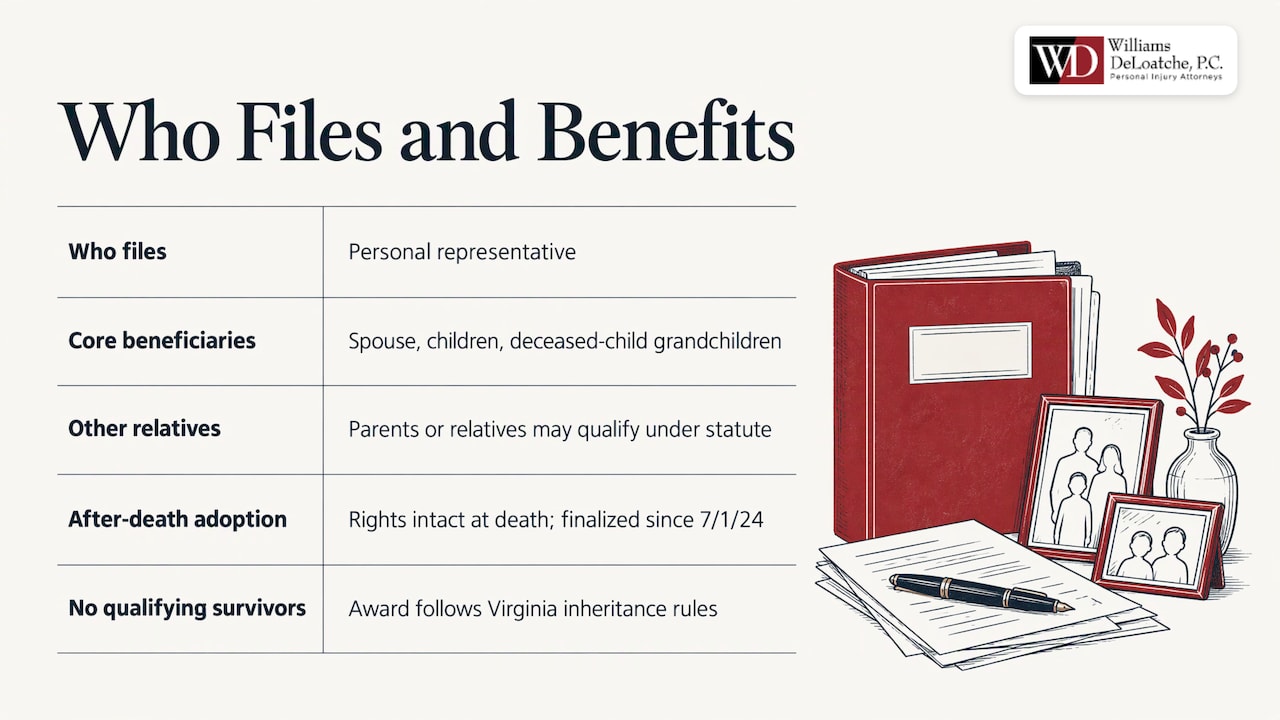
A recent change matters for blended and adoptive families. Under § 8.01-53(D), a child adopted after the decedent’s death counts as a child of the decedent, as long as the decedent’s parental rights had not been terminated before death. That applies to adoptions finalized on or after July 1, 2024.
Because the statute directs who is eligible, a family cannot simply agree among themselves to divide the money any way they like. Disputes about shares are a common source of delay, which is another reason to have an attorney involved from the start.
The deadline: two years, with limited exceptions
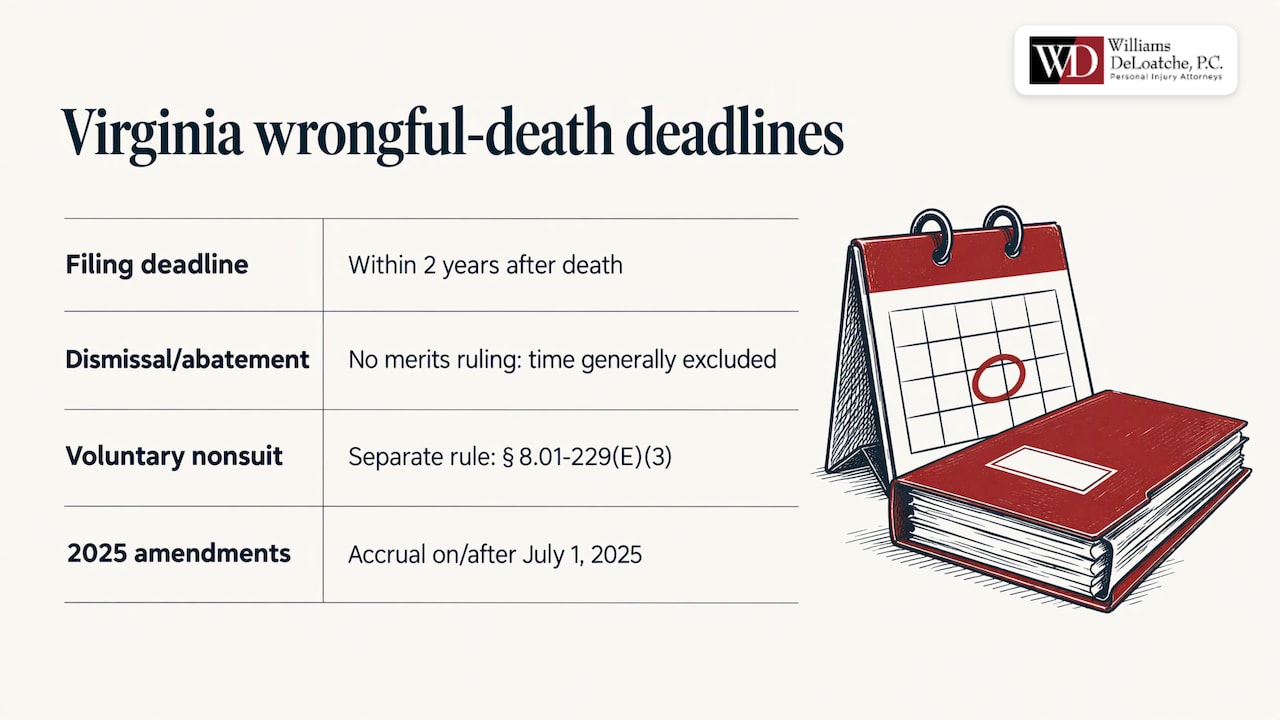
The personal representative must bring the action within two years after the death, under Va. Code § 8.01-244(B). If a timely action is dismissed or abates without a decision on the merits, the time it was pending is generally not counted against the family. A voluntary nonsuit, where the plaintiff chooses to withdraw the case, is handled under a separate section, § 8.01-229(E)(3).
The General Assembly also passed 2025 legislation (H2387) amending §§ 8.01-229 and 8.01-244, which govern death by wrongful act and the suspension of limitation periods. Those changes apply only to causes of action that accrue on or after July 1, 2025. Which version governs your case depends on the date of death, so confirm it with an attorney rather than relying on a general rule.
Two years sounds long. It is not, once you account for appointing a personal representative, gathering records, and waiting on police and medical examiner reports. Our guide on how long you have to file an injury claim in Virginia explains how filing deadlines work more broadly.
What compensation can include
People search for the “average wrongful death settlement,” but no reliable average exists for Virginia, and a single number would mislead you. The statute sets no dollar limit. A federal court applying Virginia law in Hewitt v. Firestone Tire & Rubber Co. described the statute as one that places no ceiling on recovery, with damages to be fair and just and left to the discretion of the court or jury.
The categories of damages are listed in Article 5 of the Virginia Code. They include:
- Sorrow, mental anguish and solace, which can include loss of society, companionship, comfort, guidance and kindly offices.
- Lost income the decedent reasonably would have earned, and the loss of services, protection, care and assistance they provided.
- Medical and hospital costs related to the final injury.
- Reasonable funeral expenses.
- Punitive damages where the conduct was willful or wanton, or showed a conscious disregard for the safety of others. A drunk driver or a trucking company that ignored safety rules are the kinds of situations where this question is raised.
It is also worth knowing how the money is divided. According to the U.S. Department of Justice’s summary of Virginia’s statute, damages are distributed among the statutory class in proportion to each person’s loss, with priority to the spouse and children or the descendants of children who died before the decedent. That summary dates from 2002, so the current text of § 8.01-53 controls.
Factors that move the value of a claim
No two cases are valued alike. Factors that commonly matter include:
- The decedent’s age, health and earning history. A younger wage earner with dependents generally represents a larger loss of future income and support.
- Who survives. A spouse and young children have different losses than adult children.
- Strength of the liability evidence. Police reports, crash reconstruction, surveillance video, maintenance logs, and witness statements decide whether fault can be shown.
- Available insurance and assets. A recovery is practically limited by the coverage and resources of the responsible party, which is why identifying every possible defendant early is important. In a trucking case, that can include the driver, the carrier and others.
- The decedent’s conduct. Virginia is a strict contributory negligence state, meaning insurers will look for any fault by the person who died. Careful evidence matters.
A lawyer can estimate a realistic range only after reviewing the facts, the records and the insurance available.
Proving the claim
The family must show that the other party owed a duty of care, breached it, and that the breach caused the death and the family’s losses. That sounds abstract; it comes down to documents and witnesses. Typically that means the crash report, medical and autopsy records, the death certificate, photographs, 911 recordings, employment and tax records for the income-loss calculation, and expert opinions. Competent expert testimony is admissible to prove lost income and the value of services the decedent provided.
We lay out the types of evidence in more detail in what proof is needed in a Virginia wrongful death case. If you can, keep everything: the other driver’s insurance information, photos of the scene, text messages, and any letters from an insurance adjuster. Avoid giving a recorded statement to the other side’s insurer before you have spoken with an attorney.
Settling a wrongful death claim
Most wrongful death claims resolve through negotiation, but a settlement is not simply a deal between the family and an insurer. Under Va. Code § 8.01-55, the personal representative may compromise the claim, including claims under a liability insurance policy, before or after a lawsuit is filed. That compromise is only valid with the approval of the court where the action is pending, or of a circuit court if nothing has been filed yet.
The approval step protects the beneficiaries, since the court reviews the amount and how it is divided. It also means a quick check from an insurance company is not the end of the matter. Settlements that grow out of a defective product raise their own questions, and general information on product liability settlement rights can help you understand how those payouts are typically structured.
Before accepting any offer, make sure it accounts for future losses, such as the decades of income a younger decedent would have earned, and not only the bills in front of you.
How the process unfolds
- Secure the facts. Obtain the crash or incident report, preserve photos, and write down what witnesses said while memories are fresh.
- Have a personal representative appointed. This is done through the circuit court clerk where the decedent lived.
- Notify insurers through counsel. Letting your attorney communicate with the insurance company keeps you from saying something that could be used against the claim.
- Investigate and value the claim. Your attorney gathers records, retains experts and identifies every responsible party and every source of insurance.
- Negotiate or file suit. Many cases settle, but filing before the two-year deadline keeps your rights intact.
- Seek court approval of any settlement and then distribute the proceeds to the beneficiaries according to the statute.
Wrongful death claims by region
The circumstances behind a fatal accident vary by place, and so do the questions families ask.
Hampton Roads (Williamsburg to Virginia Beach). Heavy commuter and tourist traffic, tunnels and busy interstates produce serious car, truck and motorcycle crashes, and brain injuries that later prove fatal. Slip and fall and other premises cases also arise. See our page on a Virginia Beach wrongful death attorney for more on the local picture.
Roanoke and Southwest Virginia. Mountain roads and the I-81 corridor carry significant truck traffic. Families here often face fatal tractor-trailer and car collisions and motorcycle crashes, which we handle through our truck accident and motorcycle accident practice areas.
Virginia’s Eastern Shore (Accomack and Northampton counties). Fatal crashes frequently involve speeding, reckless driving or a drunk driver. When a death follows that kind of conduct, the traffic charge and the civil wrongful death claim run on separate tracks, and the civil case does not wait on the criminal outcome.
If the death followed a pedestrian strike, our pedestrian accident practice addresses those claims. If it followed a head injury that did not kill immediately, see how we approach traumatic brain injury cases.
Working with a firm that knows your case
Williams DeLoatche, P.C. is a personal injury firm serving clients across Virginia, and wrongful death is one of our practice areas. Our approach is built around direct access to attorneys, personalized strategies shaped by your family’s situation, and communication that keeps you informed. You are not a file number here: the attorneys and paralegals working on your case are familiar with it. We handle injury matters on a contingency fee basis, which means the firm earns its fee from a settlement or court award, a point that matters to families who are also facing funeral costs and lost household income.

To talk through what happened and what options your family has, start with our wrongful death practice page or meet the attorneys who would handle your case. For how families approach accountability after a loss, you may also find our article on pursuing accountability and justice in a wrongful death claim helpful.
FAQ
Who can file a wrongful death claim in Virginia?
The personal representative of the decedent’s estate files the action, as required by Va. Code § 8.01-50. The recovery goes to the beneficiaries named in § 8.01-53, chiefly the surviving spouse, children and grandchildren of a deceased child, with parents and other relatives qualifying in certain circumstances. If no personal representative has been named, the court appoints one first.
How long do I have to file?
The general rule is two years from the date of death under Va. Code § 8.01-244(B). Legislation passed in 2025 changed parts of the related statutes for causes of action accruing on or after July 1, 2025, so the date of death matters. Contact an attorney early to confirm the deadline that applies to your case.
What is the average wrongful death payout?
There is no reliable average, because Virginia’s statute places no dollar limit on recovery and each case turns on the decedent’s earnings, the surviving family, the evidence of fault and the insurance available. Damages can include sorrow and loss of companionship, lost income and services, medical and funeral expenses, and in some cases punitive damages. An attorney can give you a realistic range after reviewing your facts.
Does a settlement need court approval?
Yes. Under Va. Code § 8.01-55, the personal representative may compromise a wrongful death claim, but only with approval of the court where the action is pending, or a circuit court if no suit has been filed. This applies to claims under a liability insurance policy as well.
Can I bring a claim if the at-fault driver was also charged criminally?
Yes. The statute applies even when the death occurred under circumstances amounting to a felony, so the civil claim is independent of any criminal case.
Sources
- Va. Code § 8.01-50, Action for death by wrongful act
- Va. Code § 8.01-53, Class and beneficiaries
- Va. Code § 8.01-244, Actions for wrongful death; limitation
- 2025 Virginia General Assembly enrolled bill H2387
- Hewitt v. Firestone Tire & Rubber Co., 490 F. Supp. 1358
- Code of Virginia, Article 5, Death by Wrongful Act
- U.S. Department of Justice, Summary of State Wrongful Death and Intestacy Statutes
- Va. Code § 8.01-55, Compromise of claim for death by wrongful act
- Product liability settlement rights
Recommended

Direct Access.
Real Results.