


Pedestrian Accident Lawyer in Virginia: What to Know
If a driver hit you while you were on foot, your claim depends on how fast you document the crash, how fault is proved, and whether you act within Virginia’s two-year deadline. A pedestrian accident lawyer handles the insurers and the evidence while you recover. At Williams DeLoatche, P.C., our pedestrian accident attorneys represent injured people and families across Virginia, and you work directly with the attorneys and paralegals who know your case.
Key Takeaways
- Get medical care first. Pedestrian injuries can be serious even when you feel able to walk away, and your medical records become the backbone of the claim.
- Virginia gives you two years from the date of injury to file a personal injury lawsuit, and wrongful death claims have their own timeline.
- Fault is the central fight in a Virginia pedestrian case, so crosswalk location, witnesses, photos and the police report matter from day one.
- Our fees come from a settlement or court award, so injured people with limited income can still be represented.
Table of Contents
- Why Pedestrian Cases Are Different From Other Crashes
- What to Do After Being Hit by a Car
- How Fault Works for a Pedestrian in Virginia
- Who Can Be Held Responsible
- What Compensation May Cover
- The Two-Year Deadline
- Pedestrian Crashes Across Our Virginia Service Areas
- What a Pedestrian Accident Lawyer Does for You
- Talk to Us About Your Pedestrian Accident
- FAQ
- Sources
Why Pedestrian Cases Are Different From Other Crashes
A driver is protected by a steel frame, a seat belt and an airbag. A pedestrian has nothing. That gap shows up in the injuries, in the size of the medical bills and in how insurers treat the claim.
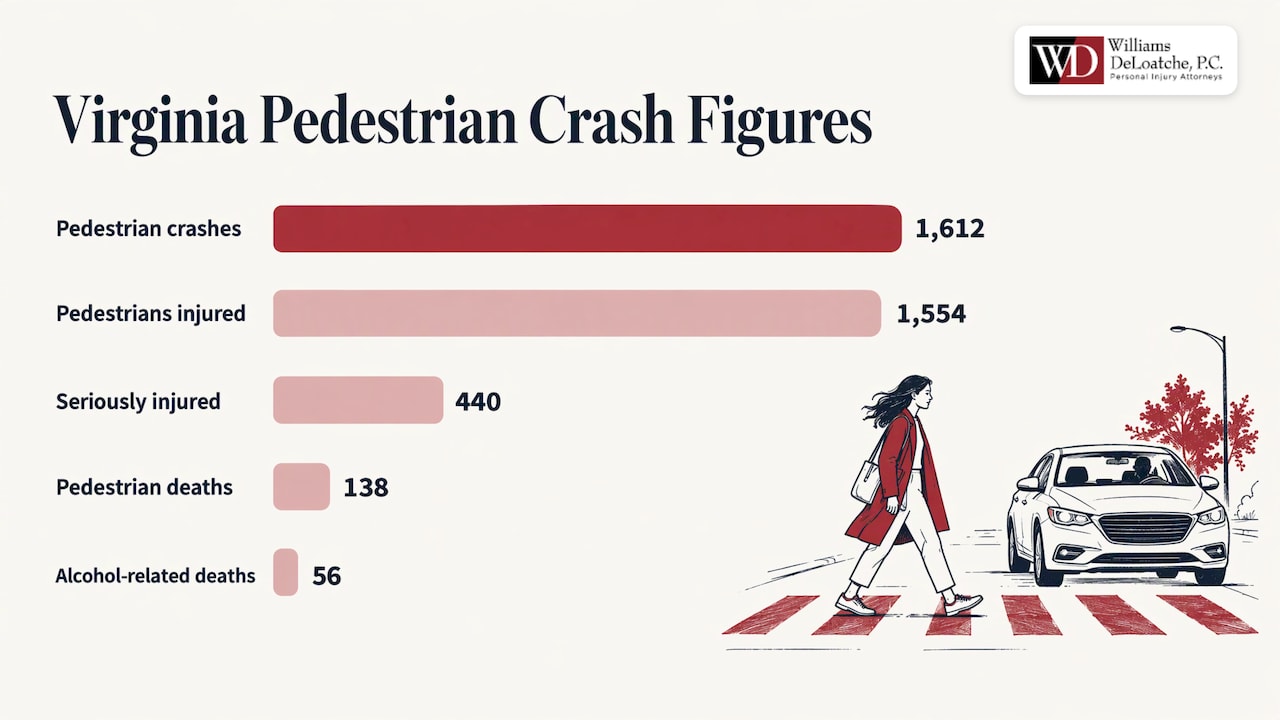
Virginia’s numbers show the scale. The Virginia DMV’s 2025 crash report records 1,612 pedestrian crashes, 1,554 pedestrians injured, 440 of them seriously, and 138 pedestrian deaths, up 9.5% from 2024. The same report counts 56 alcohol-related pedestrian fatalities. Crashes fell slightly, but the deaths rose, which tells you how little margin a person on foot has.
The state’s Strategic Highway Safety Plan also finds that 54 percent of pedestrian deaths and serious injuries happen away from intersections, in mid-block locations. That detail matters for your claim, because mid-block crashes are where drivers most often argue the pedestrian should not have been there.
What to Do After Being Hit by a Car
You may be in pain, frightened or unable to remember the moment of impact. Do what you can, in this order.
1. Get medical attention immediately
Emergency crews are trained to treat pedestrians seriously. The CDC’s field triage guidelines direct EMS to take a pedestrian who was thrown, run over or struck at an estimated impact over 20 mph to a trauma center or a hospital able to evaluate them thoroughly. If paramedics recommend transport, go.
A peer-reviewed review of pedestrian injuries notes that these collisions can cause head, leg and pelvic trauma, and that even slow-to-moderate-speed impacts can cause chest, abdominal, pelvic and long-bone injuries. The same review observes that victims often cannot recall the collision. If you felt fine at the scene but have a headache, confusion, dizziness or abdominal pain later, get checked right away. Head injuries in particular can be missed at first, which is why we treat traumatic brain injury cases with such care.
2. Call the police and ask for the report number
Under Va. Code § 46.2-373, as amended in 2025, an officer investigating a crash with an injury, a death or at least $3,000 in property damage must send a written report to the Virginia DMV within 24 hours, including each vehicle’s insurance carrier. A pedestrian injury crash therefore produces an official report. Note the officer’s name and the report number so you or your lawyer can request it.
3. Document what you can
If you are able, or if a friend can help:
- Photograph the scene, the crosswalk or signals, skid marks, lighting and the vehicle, including any damage and its license plate.
- Get names and phone numbers of witnesses before they leave.
- Photograph your injuries, torn clothing and damaged phone or glasses.
- Keep every medical record, bill and pharmacy receipt, and write down missed work days.
Physical evidence carries weight. The Royal Society’s primer on forensic collision investigation explains that investigators correlate a pedestrian’s injuries with contact marks on the vehicle, and that eyewitness accounts are weighed against that physical evidence. Our vehicle damage guide shows how damage on a car can point to what happened.
4. Be careful with the other driver’s insurer
The adjuster may call within days, sound sympathetic and ask for a recorded statement. Give your basic contact information and say you will follow up. Do not guess about speed, distance or whether you looked. Because fault decides everything in Virginia, an offhand remark can be used against you. Send the adjuster to your attorney.
How Fault Works for a Pedestrian in Virginia
Most people assume that a driver who hits a pedestrian is automatically liable. In Virginia, the law is more demanding on the injured person, so the details matter.
What drivers must do
Under Va. Code § 46.2-924, as amended in 2025, a driver must stop for a pedestrian in the driver’s lane, or an adjacent lane approaching it, at a clearly marked crosswalk, at an unmarked crossing at the end of a block, and at any intersection on a road with a speed limit of 35 mph or less. A violation that causes serious bodily injury to or the death of a vulnerable road user is a Class 1 misdemeanor. Drivers also cannot pass a vehicle that has stopped for a pedestrian, a point the DMV’s highway safety report describes in connection with HB 1705.
What pedestrians must do
The Code of Virginia’s pedestrian article asks pedestrians to cross, wherever possible, only at intersections or marked crosswalks, and it sets out when crossing between intersections is allowed. Insurers look for any way to say you broke these rules.
Why shared fault is dangerous in Virginia
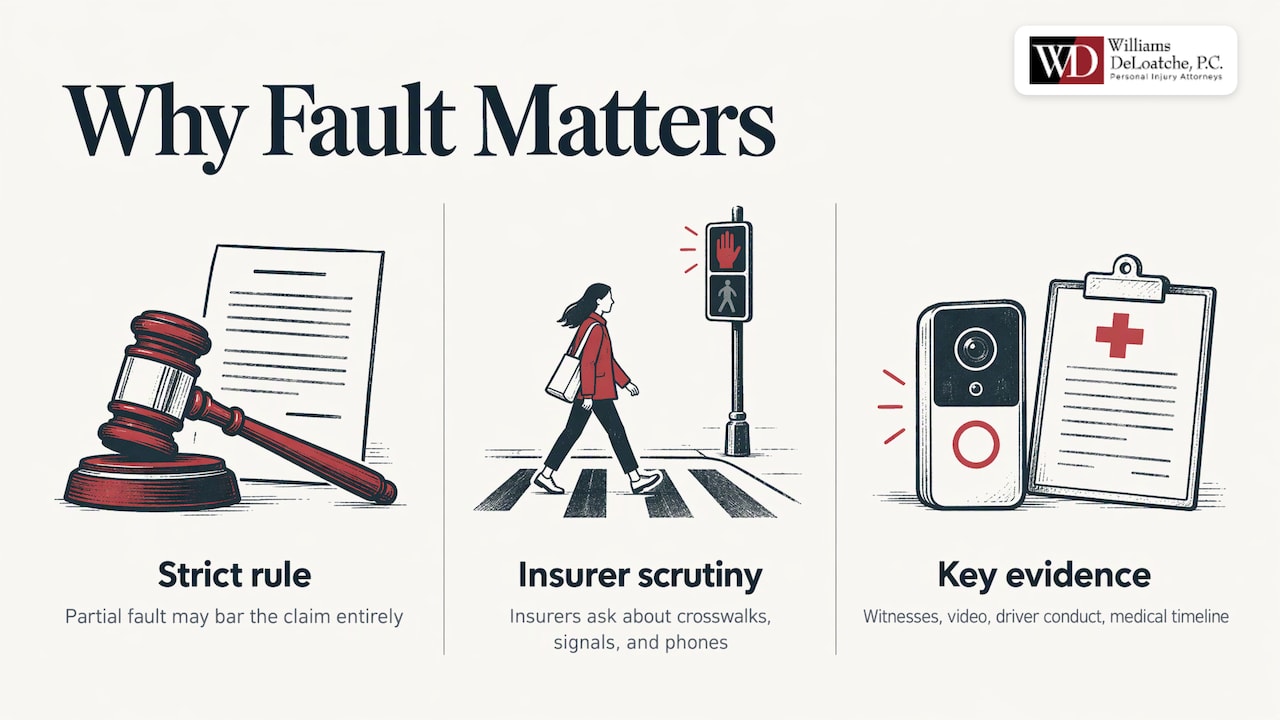
Virginia follows a strict contributory negligence rule. In general terms, if a court finds the injured person was partly at fault, the claim can be barred entirely rather than reduced. That is stricter than the approach in most states, and it is why insurers press so hard on questions like whether you were in the crosswalk, whether the signal had changed, or whether you were looking at a phone.
A lawyer’s job here is to build the record before the insurer builds its version: witness statements, traffic signal timing, surveillance or doorbell video, the driver’s phone and conduct, and the medical timeline. Evidence like this often disappears within days, which is one reason to call early.
Who Can Be Held Responsible
The driver is the usual target, but not the only one. Depending on the facts, responsibility can reach:
- An employer. If the driver was on the job, a company may share liability. When the vehicle is a tractor-trailer, our truck accident team handles the added layers of carriers, logs and insurers. Bus crashes raise similar questions, covered in our guide to bus accident lawyers in Virginia.
- A property owner. If a hazard on a lot or walkway contributed, such as broken pavement or poor lighting, a premises liability claim may apply.
- Your own insurance. If the driver fled or carried no insurance, coverage on your own auto policy may come into play. Policies differ, so bring yours to your first conversation with an attorney.
Alcohol is part of the picture in many serious pedestrian crashes. When an impaired driver hit you, the criminal case and your injury claim run on separate tracks, and the injury claim is yours to pursue whatever happens in court.
What Compensation May Cover
A pedestrian injury claim seeks to cover the full cost of what the crash took from you. That typically includes:
- Emergency care, surgery, hospital stays, rehabilitation and future treatment
- Lost wages and reduced ability to earn
- Pain and suffering
- Permanent injury or scarring
- Property damage, such as a phone, bicycle or glasses
- In a fatal crash, the losses of the family through a wrongful death claim
One Virginia rule helps working people directly. Va. Code § 8.01-35 provides that damages for lost income in a personal injury or wrongful death suit are not reduced because the income was replaced from another source.
The amount depends on the severity and permanence of the injuries, the medical costs, how long you are out of work, the available insurance, and how clearly fault is proved. No honest lawyer can promise a number before reviewing your records. For a realistic sense of timing, read how long a pedestrian accident settlement takes.
The Two-Year Deadline
Va. Code § 8.01-243(A) requires an action for personal injuries to be brought within two years after the cause of action accrues. If you miss it, the court will likely refuse to hear your case, however strong it is. Two years sounds long, but medical treatment, insurer negotiations and evidence gathering consume time quickly. Our article on how long you have to file a personal injury claim in Virginia explains how the clock works in more situations. If a loved one died, speak with an attorney promptly about the separate wrongful death rules.
Pedestrian Crashes Across Our Virginia Service Areas
Pedestrian injuries are not confined to big-city downtowns. Where you were hurt shapes the evidence and the likely defendants.
- Hampton Roads. Busy corridors in Virginia Beach, Norfolk and Chesapeake, and the roads around Williamsburg, put walkers, joggers and cyclists near fast traffic. Head trauma is a major concern in these cases. Our Williamsburg accident lawyers and car accident attorneys serve the region.
- Roanoke and Southwest Virginia. Rural highways often lack sidewalks and lighting, and trucks share the road. Our Christiansburg office handles car and truck crashes, brain injuries and wrongful death claims for families in the area.
- Virginia’s Eastern Shore. In Accomack and Northampton counties, long stretches of two-lane road mean high speeds and few places for a pedestrian to be seen. We represent people hurt in crashes with speeding, reckless or drunk drivers, and we also handle DUI defense matters on the Shore.
If you were on a bicycle rather than on foot, see our page on bike accident claims. You can see all our locations on the service areas page.
What a Pedestrian Accident Lawyer Does for You
Here is what we do at each stage, and why it matters.
- Reviews the crash and your injuries. We look at the report, the medical records and the scene to identify who may be responsible and where the insurer will push back.
- Preserves evidence. Video gets overwritten and witnesses move. We work to secure what proves where you were and what the driver did.
- Handles the insurers. Calls, letters and recorded-statement requests go through us, so you are not negotiating while in pain.
- Builds the value of the claim. That means medical costs today and tomorrow, lost income and the effect on daily life, not just the bills you have received so far.
- Negotiates, and goes to court if needed. Our approach combines skilled negotiation with compassionate representation. We have secured settlements for clients, including over $1.5 million in a motor vehicle accident case.
You are not treated as a file number. You can reach the attorneys on your case, and the attorneys and paralegals know your story. Our fees come from a settlement or court award, a structure that opens the door to representation for people who cannot pay a lawyer out of pocket while they are also paying medical bills.
Talk to Us About Your Pedestrian Accident
If you or someone in your family was hit by a car in Hampton Roads, the Roanoke area or on the Eastern Shore, our pedestrian accident attorneys can review what happened and explain your options. We handle car, truck and motorcycle crashes, brain injuries and wrongful death claims across Virginia, all listed on our practice areas page.

Bring the police report number, photos, medical paperwork and your insurance information if you have them. If you do not have everything yet, call anyway. The deadline is running, and we can help you collect the rest.
FAQ
Do I need a lawyer if the driver was clearly at fault?
It is worth having one. Even when fault seems obvious, Virginia’s strict fault rule gives insurers a reason to argue you share blame. A lawyer protects your statements, gathers evidence early and values the full cost of your injuries.
How much does it cost to hire a pedestrian accident lawyer?
Williams DeLoatche earns its fee from a settlement or court award rather than from hourly billing. Ask any attorney to explain the fee terms in writing before you sign.
What if I was hit while crossing outside a crosswalk?
You may still have a claim, but it will be contested harder. Virginia’s pedestrian statutes address when crossing between intersections is allowed, and a driver can still be responsible for reckless or inattentive driving. Speak to an attorney quickly so the facts are preserved.
What if the driver left the scene or had no insurance?
Report the crash to the police right away and tell your own insurer. Coverage on your auto policy may apply, depending on its terms. An attorney can review your policy and the options.
How long do I have to file?
Virginia generally gives you two years from the date of injury to file a personal injury lawsuit. Wrongful death claims follow their own rules, so a family should speak with an attorney soon.
Sources
- Virginia DMV, 2025 Virginia Traffic Crash Facts
- VDOT, Virginia 2022-2026 Strategic Highway Safety Plan
- CDC, Guidelines for Field Triage of Injured Patients
- Pedestrian Injuries: Emergency Care Considerations
- Selected Acts of the 2025 Virginia General Assembly
- Royal Society, Forensic collision investigation
- Code of Virginia, Article 16. Pedestrians
- Virginia DMV, Highway Safety Report
- Code of Virginia, Injury to Person or Property (§ 8.01-35)
- Code of Virginia, Personal Actions (§ 8.01-243)
Recommended

Direct Access.
Real Results.