


Distracted Driving Accident Lawyer in Virginia: Your Claim
If a driver who was looking at a phone, a screen or anything but the road hurt you or someone you love, a distracted driving accident lawyer does the work that is hard to do while you recover: proving what the other driver was doing, valuing your full losses, and negotiating with an insurer whose job is to pay less. At Williams DeLoatche, P.C., you speak directly with your attorneys, and the attorneys and paralegals who know your file work on it from start to finish. You are not a number to us.
This guide explains how distracted driving claims work in Virginia: what the law says, how fault is shown, what compensation can cover, how fees work, and what to do in the first days after a crash.
Key Takeaways
- Virginia law bans holding a handheld phone while driving, and a violation can be strong evidence that the other driver failed a basic duty of care.
- Distraction is rarely admitted at the scene. Phone records, witnesses, vehicle data and video are often what prove it, and some of that evidence disappears quickly.
- Most Virginia personal injury claims must be filed within two years, so early action protects your options.
- Our fees are contingency fees, paid from a settlement or court award, so you can hire us without paying legal fees up front.
- We represent injured people in Hampton Roads, the Roanoke area and the Eastern Shore, and you can reach your attorney directly.
Table of Contents
- Why distracted driving crashes are so common, and so serious
- What Virginia law says about phones and driving
- How a distracted driver is proven at fault
- What a distracted driving accident lawyer does for you
- What compensation can cover
- How shared fault can affect your claim
- What to do after a distracted driving crash
- The deadline to file in Virginia
- How legal fees work, and what if money is tight
- Where we help in Virginia
- Talk to a lawyer who knows your file
- FAQ
- Sources
Why distracted driving crashes are so common, and so serious
Distraction is not a rare cause of crashes. NHTSA reports that in 2022, 3,308 people were killed and an estimated 289,310 were injured in U.S. crashes involving distracted drivers. About 12% of injury crashes that year were distraction-affected.
Virginia’s own numbers are just as sobering. The Virginia DMV’s 2025 Traffic Crash Facts report records 17,357 distracted-driver crashes in the state, with 116 people killed and 12,256 injured. The three most common categories were eyes not on the road, cell phone or texting, and looking at a roadside incident. The same report shows that 53 distracted-driving deaths involved a driver who was also speeding.
The DMV’s Distracted Driving Toolkit notes that distracted-driving crashes are most prevalent in several places, including Norfolk and Virginia Beach, which matters if you were hurt in Hampton Roads.
There are three kinds of distraction, according to the Virginia DMV:
- Manual: hands off the wheel.
- Visual: eyes off the road.
- Cognitive: mind off driving.
The DMV explains that cognitive distraction carries the highest risk, because when the brain is handling two tasks, driving becomes the secondary one. That is why a driver on a hands-free call can still cause a serious crash, and why your claim should not be limited to phone use alone.
What Virginia law says about phones and driving
Virginia’s handheld ban is found in Code of Virginia § 46.2-818.2. It is unlawful to hold a handheld personal communications device while driving a moving vehicle on a Virginia highway. The law has narrow exceptions, including emergency-vehicle operators on duty, drivers who are lawfully parked or stopped, and reporting an emergency.
The penalties for the driver are:
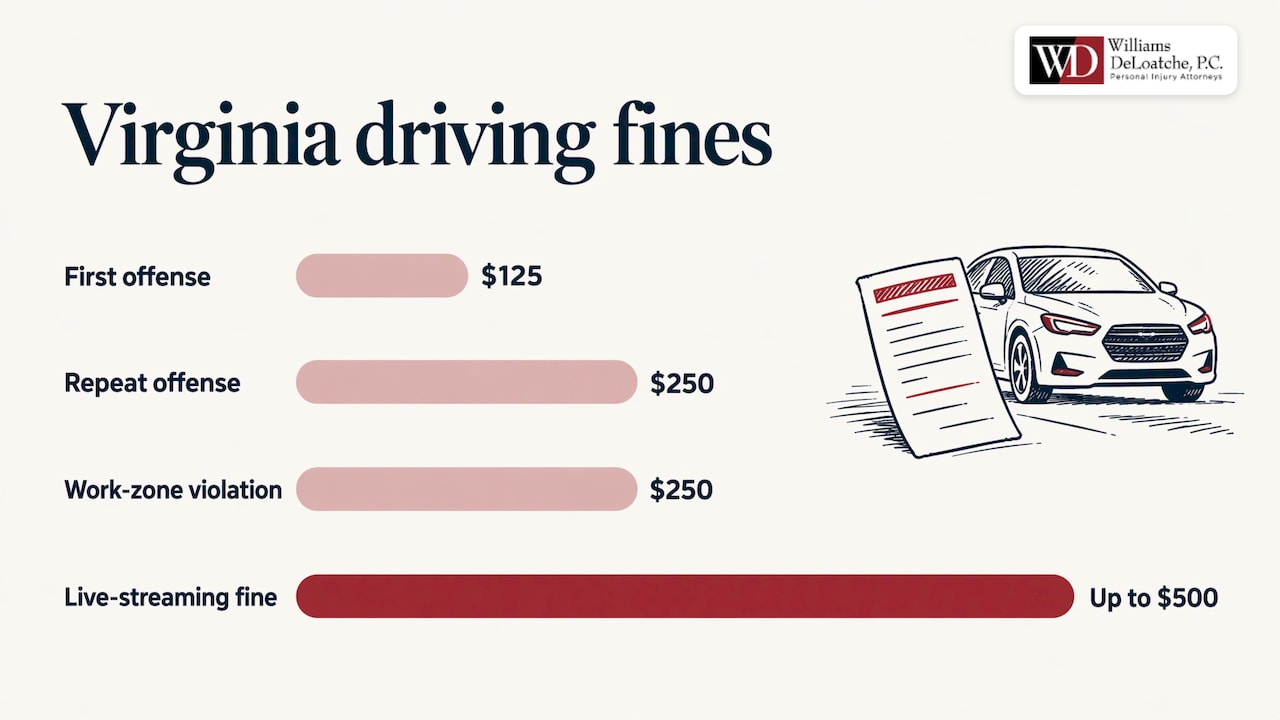
| Violation | Fine |
|---|---|
| First offense | $125 |
| Second or subsequent offense | $250 |
| Violation in a highway work zone | $250 mandatory |
A new 2026 provision, § 46.2-818.3, also bans live-streaming interactions while driving, with fines of up to $500 and license suspensions for repeat offenses, according to the same Code of Virginia page.
These fines are the criminal and traffic side of the story. They punish the driver. They do not pay your medical bills. Your compensation comes from a separate civil injury claim, usually against the at-fault driver’s insurance. A traffic conviction can help your case, but you do not need one to win a claim, and the absence of a ticket does not mean the driver was not distracted.
How a distracted driver is proven at fault
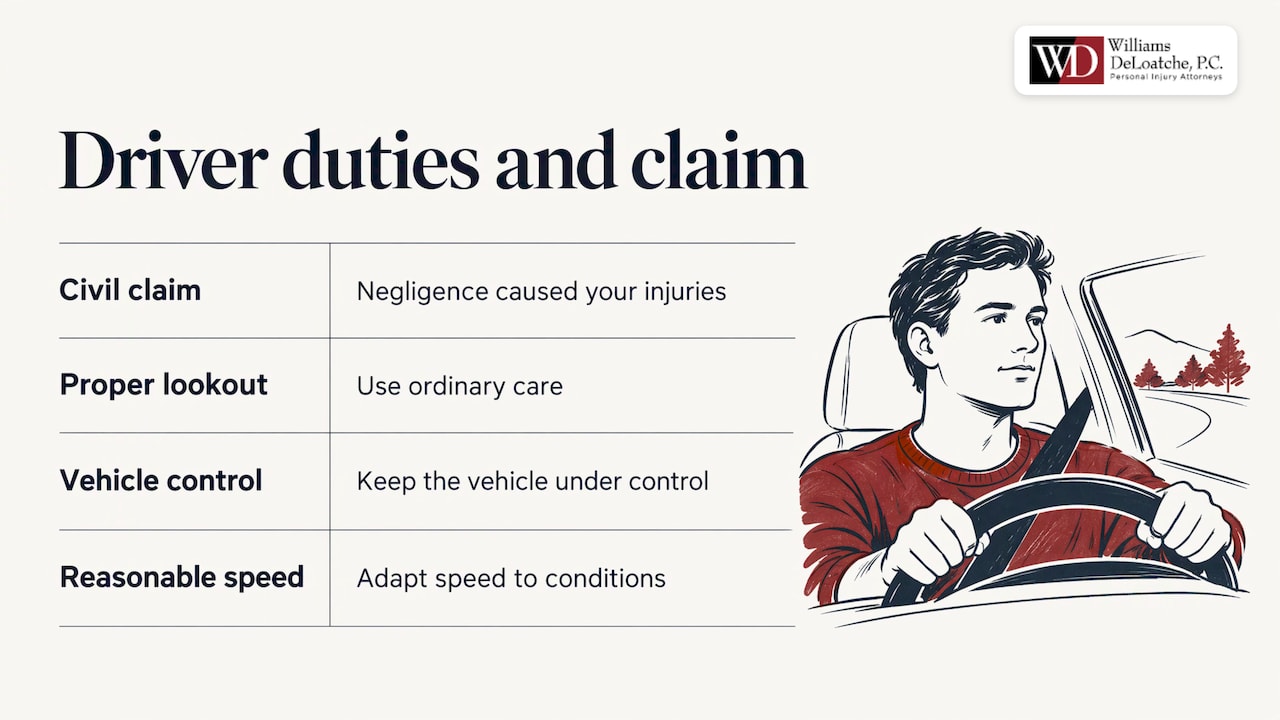
In a civil claim, you must show that the other driver was negligent and that this negligence caused your injuries. Virginia’s Model Jury Instructions (Release 26, April 2026) state that every driver has a duty to use ordinary care to keep a proper lookout, keep the vehicle under proper control, and drive at a reasonable speed for the conditions. A driver who fails any of those duties is negligent.
That is why distraction matters so much. A driver who is reading a text is not keeping a proper lookout. You do not need to prove the driver meant to hurt anyone, only that they did not use ordinary care.
The hard part is evidence. Drivers rarely say, “I was looking at my phone.” The proof usually comes from several places.
Evidence that can show distraction
- The police report. Officers note citations, statements and the position of the vehicles. A citation under the handheld law is a strong lead.
- Witness statements. Other drivers, passengers and pedestrians often saw the driver looking down or drifting.
- Phone records. Call logs, text timestamps and app activity can be compared with the exact time of the crash.
- Vehicle data. Many newer vehicles store speed, braking and steering data that can show a driver never slowed before impact.
- Video. Traffic cameras, business surveillance, dash cameras and doorbell cameras may capture the crash or the moments before it. This footage is often overwritten within days or weeks.
- Crash physics. No skid marks and no braking before impact can suggest the driver never saw you.
Phone records and vehicle data are usually in the other side’s hands, and they will not hand them over because you ask. A lawyer can send a preservation letter early, asking the other driver and their insurer to keep the evidence, and can pursue the records through the legal process if a claim goes into litigation. Our article on how to prove fault in a Virginia car accident walks through this evidence in more detail.
When the other driver was distracted and also speeding or reckless
Distraction often comes with other bad choices. The 2025 Virginia DMV data above shows how often distracted drivers were also speeding. If you were hurt on the Eastern Shore, for example on Route 13 in Accomack or Northampton County, a crash caused by a distracted driver may also involve speeding or reckless driving charges against that driver. We handle traffic matters on the Eastern Shore, including speeding, reckless driving and DUI, as well as crashes involving cars and trucks. Those facts can strengthen your injury claim because they show more than one failure of care.
If alcohol was involved as well, see our page on drunk driver accident claims.
What a distracted driving accident lawyer does for you
A good injury lawyer does more than file paperwork. In a distracted driving case, the work looks like this:
- Evaluates your case. We look at the crash, your injuries, the insurance available and the evidence that exists now.
- Preserves evidence. Video, vehicle data and phone records can vanish. Fast requests keep them alive.
- Builds the medical story. Your records, treatment plan and future care needs are organized so the full extent of your injuries is documented.
- Values the claim. That means counting medical bills, lost income and the harder-to-price losses, not just the bills in your hand today.
- Handles the insurers. Adjusters ask for recorded statements and quick releases. Skilled negotiation is how a claim is pushed toward what it is actually worth.
- Takes the case to court when needed. If a fair settlement is not offered, a lawsuit has to be filed before the deadline.
We are a firm that has secured substantial settlements, including over $1.5 million for motor vehicle accidents. Every case is different, and past results do not guarantee a future outcome, but they reflect how seriously we approach negotiation. Our approach pairs that negotiation with direct access to your attorney and a strategy built around your own situation.
What compensation can cover
Compensation in a Virginia injury claim is meant to address what the crash cost you. It commonly includes:
- Past and future medical expenses, including hospital care, surgery, therapy and medication
- Lost wages and reduced ability to earn income
- Pain, suffering and loss of enjoyment of life
- Property damage to your vehicle and belongings
- In a fatal crash, the losses that a family suffers through a wrongful death claim
The size of a claim depends on how severe the injuries are, how long recovery takes, whether you can return to work, how clearly fault can be shown, and how much insurance coverage is available. Severe injuries cost far more than the first estimate suggests. NHTSA estimates that distracted-driving crashes cost the nation $98 billion in economic costs in 2019, and about $395 billion once quality-of-life losses are counted, according to its research note. Those numbers are a reminder that the harm goes well beyond the repair bill.
Brain injuries and other catastrophic harm
A distracted driver often does not brake before impact, and that can mean higher-energy collisions. Head trauma is one of the injuries that can look minor at first and change a life later: memory problems, headaches, mood changes and trouble working. If you were hit in Hampton Roads or the Roanoke Valley and have any of these symptoms, see a doctor, then talk with us about our traumatic brain injury representation. A brain injury claim needs careful medical documentation, because the full cost may not be known for months or years.
If a loved one died in a crash, our wrongful death team can explain what the family may pursue.
How shared fault can affect your claim
Insurers often try to blame the injured person. They may say you were speeding, changed lanes suddenly or were not paying attention either. In Virginia, an argument that you were partly at fault can seriously damage a claim, which is why this is the point where many people without a lawyer lose ground. Fault is decided by evidence, not by what the adverse adjuster says on the phone.
Three practical rules follow:
- Do not guess about fault in conversations with an insurer. Stick to the facts you know.
- Do not give a recorded statement to the other driver’s insurer before talking with a lawyer.
- Keep every record of what happened, including photos, so the account of the crash is not left to the other side.
We go through these points in our guide to proving fault in Virginia, and we apply them to your specific facts when you call.
What to do after a distracted driving crash
What you do in the first days shapes the claim. Our guide to the steps to take after an auto accident covers the basics. For a suspected distracted driver, add these:
- Call 911 and get medical care. Some injuries, including concussions, do not show at once. A prompt medical record also links your injuries to the crash.
- Call the police to the scene. Ask that the report note anything you saw, such as a phone in the driver’s hand.
- Take photos and video. Capture vehicle positions, damage, road conditions, skid marks and your injuries.
- Get names and contact details for the driver, passengers and any witnesses.
- Note nearby cameras. Write down businesses, traffic cameras or homes with doorbell cameras facing the road.
- Say little to insurers. Report the crash, but do not give a recorded statement or sign a release without legal advice.
- Call a lawyer early. The sooner evidence is requested, the more likely it is to still exist.
A motorcycle rider or cyclist hit by a driver who was looking at a phone has the same priorities. See our pages on motorcycle crashes and bike accidents.
The deadline to file in Virginia
Under Va. Code § 8.01-243, claims for personal injury generally must be filed within two years, and the same period applies to a wrongful death claim from the date of death. Property damage has a longer period of five years. Special rules can shorten or extend time in particular circumstances, such as claims involving a government vehicle, so do not wait to find out which rules apply to you. Our article explains how long you have to file a personal injury claim in Virginia.
Two years sounds long. It is not, once treatment, insurance back-and-forth and the search for records are counted. Evidence is also weaker the longer you wait.
How legal fees work, and what if money is tight
Many injured people worry that they cannot afford a lawyer while they are out of work and paying medical bills. Our firm earns its fee through a contingency fee: we are paid from a settlement or court award, not by you out of pocket each month. That arrangement means a lower-income family can have the same attorney access and the same skilled negotiation as anyone else.
When you call, we can explain how the fee works in your case and what costs to expect, so there are no surprises. If you are not sure whether your situation even needs a lawyer, our article on what to do when someone hits your car can help you think it through.
Where we help in Virginia
- Hampton Roads (Williamsburg to Virginia Beach, including Norfolk and Chesapeake): car crashes, truck and motorcycle accidents, slip and fall, and brain injuries. See our Virginia Beach car accident page and our Williamsburg car accident attorneys.
- Roanoke and southwest Virginia: car accidents, trucking accidents, motorcycle crashes, wrongful death and brain injuries.
- Eastern Shore (Accomack and Northampton counties): traffic matters such as speeding, reckless driving and DUI, along with car and truck crashes.
Talk to a lawyer who knows your file
A distracted driver’s insurer will have a team ready within hours. You should too. At Williams DeLoatche, P.C., our personal injury attorneys handle car, truck and motorcycle crashes, pedestrian and bike accidents, brain injuries and wrongful death. You get direct access to the attorneys on your case, and your paralegals and attorneys stay familiar with your claim from first call to resolution. Review our personal injury practice areas or go straight to our car accident attorneys to start.

If you are reading this for a family member who cannot yet speak for themselves, you can call on their behalf. We will tell you what we need and what can wait.
FAQ
Do I need a lawyer if the other driver admitted they were on their phone?
An admission helps, but it does not set the value of your claim or stop an insurer from disputing your injuries or blaming you. A lawyer ensures the admission is documented, the evidence is preserved and your full losses are counted. It also keeps you from accepting a quick offer that does not cover your future care.
What if there was no ticket for distracted driving?
A claim does not depend on a ticket. Fault in a civil case is decided on the evidence, including witness accounts, phone records, vehicle data and video. A citation can help, but its absence does not mean the driver was not distracted.
How long do I have to file a distracted driving injury claim in Virginia?
Personal injury and wrongful death claims are generally subject to a two-year deadline under Va. Code § 8.01-243, and property damage has five years. Because exceptions exist, speak to an attorney as soon as you can.
How much does it cost to hire a distracted driving accident attorney?
We are paid through contingency fees from a settlement or court award, so you do not pay legal fees up front. We will explain how this works for your case when you contact us.
Sources
- NHTSA, Traffic Safety Facts Research Note: Distracted Driving 2022
- Virginia DMV, 2025 Traffic Crash Facts
- Virginia DMV, Distracted Driving Toolkit
- Virginia DMV, Distracted Driving
- Code of Virginia, Title 46.2, Chapter 8, Article 1
- Virginia Model Jury Instructions, Civil
Recommended

Direct Access.
Real Results.