


Uninsured Motorist Lawyer in Virginia: When You Need One
If an uninsured or underinsured driver hurt you in Virginia, your own auto policy is often the main source of payment, and your own insurer becomes the party you negotiate against. An uninsured motorist lawyer handles that claim for you: proving the other driver was at fault, documenting your injuries and losses, and pressing your insurer for a fair payment. At Williams DeLoatche, P.C., our attorneys represent crash victims across Virginia, including Hampton Roads, the Eastern Shore and the Roanoke area, on a contingency fee basis, so we are paid from a settlement or verdict.
Key Takeaways
- Virginia auto liability policies must include uninsured and underinsured motorist (UM/UIM) coverage unless a named insured rejects the additional coverage in the way the law requires.
- UM coverage also applies when a hit-and-run driver cannot be identified, but the notice and reporting steps matter.
- Your own insurer decides your claim, so the way you document injuries and the way you communicate with the adjuster affect the result.
- Contingency fee representation means no attorney fee unless there is a recovery, though case costs should be explained in writing before you sign.
- Report the crash promptly and talk to a lawyer before you give a recorded statement or accept an offer.
Table of Contents
- What an uninsured motorist lawyer actually does
- How UM and UIM coverage work in Virginia
- Why minimum insurance often falls short
- Hit-and-run crashes and “John Doe” lawsuits
- What to do after a crash with an uninsured driver
- How priority works when more than one policy applies
- Costs: how contingency fees work
- What your claim can include
- Serving crash victims across Virginia
- When to call a lawyer
- Work with Williams DeLoatche
- FAQ
- Sources
What an uninsured motorist lawyer actually does
A UM or UIM claim is not a claim against the driver who hit you. It is a claim under your own insurance contract. That surprises many people, because the insurer you have paid premiums to for years is now the company deciding how much your injuries are worth.
The Virginia State Corporation Commission, which regulates insurance in the state, explains in its Auto Insurance Consumer Guide that UM coverage provides bodily injury and property damage protection when you are in an accident caused by an uninsured motorist or a hit-and-run driver. UIM coverage protects you when the at-fault driver’s liability limits are lower than your own UM/UIM limits.
In practice, a lawyer on these claims will:
- Establish that the other driver was at fault and that you were not.
- Gather the police report, photographs, witness statements and medical records.
- Identify every policy that may apply to you, since more than one can.
- Put together a demand that accounts for medical bills, lost income, pain and suffering and future care.
- Negotiate with your insurer, and file suit when a fair resolution is not offered.
Our attorneys and paralegals are familiar with your case, and you have direct access to the attorney handling it. For an injured person trying to recover while also answering adjuster calls, that matters.
How UM and UIM coverage work in Virginia
Virginia sets the framework in Va. Code § 38.2-2206. Three points matter most to you.
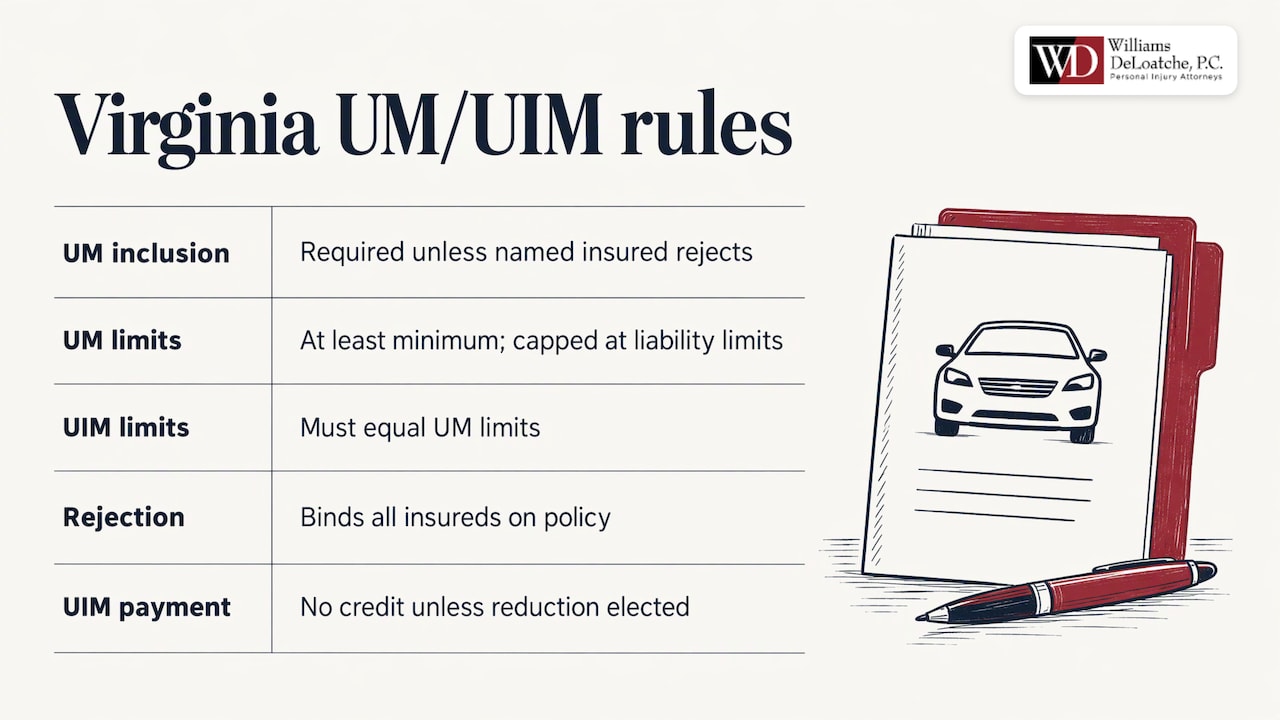
Coverage is built into your policy. Auto liability policies must include UM coverage at limits at least equal to the statutory minimums and equal to, but not greater than, the policy’s liability limits, unless a named insured rejects the additional coverage by notifying the insurer as the law provides. UIM limits must equal your UM limits.
One rejection binds everyone. When one named insured rejects the additional coverage, that rejection is binding on all insureds under the policy. If you were hurt as a passenger or a family member on someone else’s policy, ask early what was actually elected.
Underinsured coverage can stack on top of the at-fault driver’s insurance. UIM coverage is paid without any credit for the at-fault driver’s available bodily injury or property damage coverage, unless a named insured signs an election to reduce UIM payments by that amount. Whether that election exists on your policy can change the value of your claim considerably, and it is the kind of detail we look for when we review a policy.
What changed in 2026
Virginia amended Code § 38.2-2202 through SB 1159 in the 2025 session, effective January 1, 2026. According to the ACORD forms bulletin of November 2025, the change introduced updated Virginia UM notice and UIM election forms and made no substantive changes to coverage requirements, dollar amounts or time limits. The core protections for crash victims are the same as before.
Why minimum insurance often falls short
Virginia’s minimum liability limits rose for newer policies. The Virginia DMV lists $50,000 for injury or death of one person, $100,000 for two or more people and $25,000 for property damage on policies effective on or after January 1, 2025. Earlier policies carried $30,000, $60,000 and $20,000.
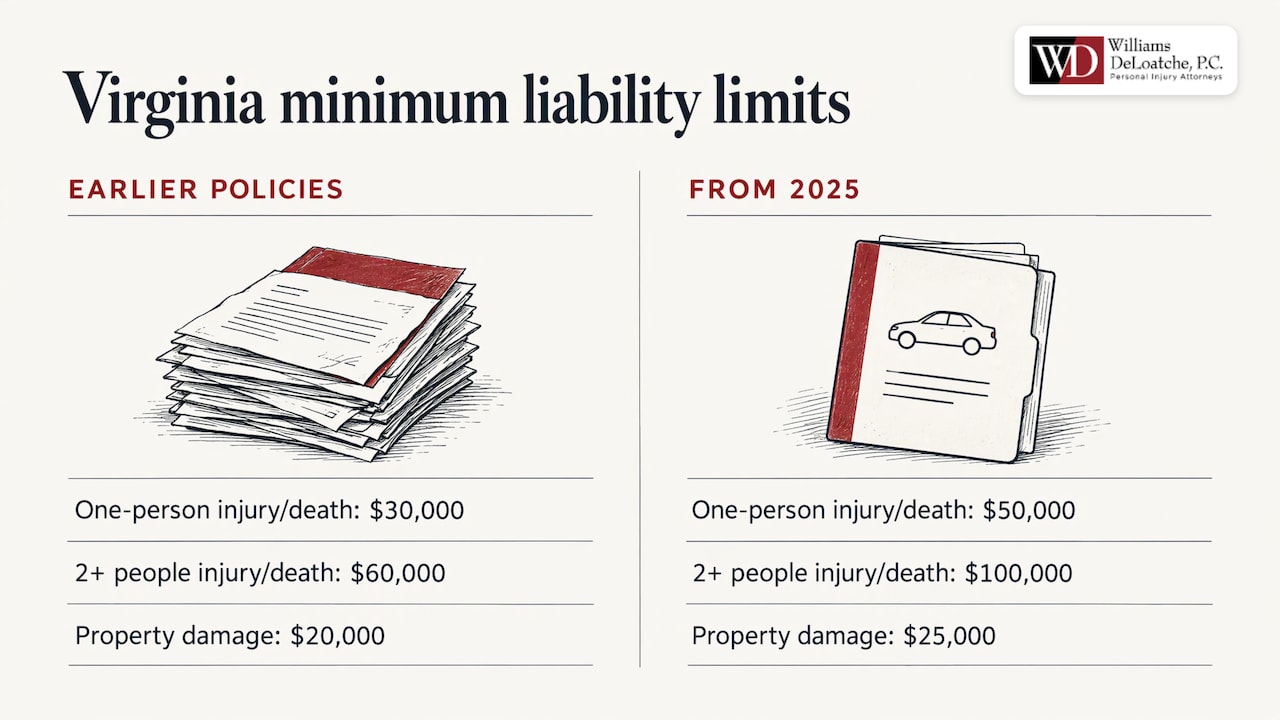
Those figures are small next to a serious crash. A hospital stay, surgery, months away from work or a traumatic brain injury can pass $50,000 quickly. When the at-fault driver carries only the minimum, or none, your UIM or UM coverage is what stands between you and the unpaid balance. That is why the limits on your own policy matter, and why we review them at the start of every case.
Hit-and-run crashes and “John Doe” lawsuits
When the driver who hit you flees and cannot be identified, UM coverage can still apply. Under § 38.2-2206, an insured can bring suit against the unknown driver as “John Doe,” serving the court clerk and the UM insurer. The law also expects you to report an accident with no contact between vehicles promptly to your insurer or to law enforcement.
That is a procedural path with real traps. A missed notice or a late report gives your insurer something to argue about. Our guides on what to do in a hit-and-run accident in Virginia and the proof you need after a hit-and-run walk through the steps in more detail, and our hit-and-run victim guide covers the first hours after a crash.
What to do after a crash with an uninsured driver
- Get medical care first. Your health comes first, and treatment records become the backbone of your claim.
- Call the police and make sure a report is filed, even for a driver who leaves.
- Collect what you can. Photographs of vehicles and the scene, the other driver’s plate and details, names of witnesses.
- Notify your insurer promptly, and stick to basic facts about when and where the crash happened.
- Keep a record. Save bills, pay stubs, receipts and a short daily note on pain and limits on your activity.
- Speak with an attorney before giving a recorded statement or signing any release or settlement.
The deadline to file suit is strict in Virginia, and your policy can add its own notice requirements. Because the timing can depend on the facts, we recommend you call us early so that nothing is lost while you recover.
How priority works when more than one policy applies
If you are covered by several UM/UIM policies, Virginia sets an order. Under § 38.2-2206, the policy on the vehicle you were occupying comes first. Next is a policy on an uninvolved vehicle where you are a named insured, then a policy where you are a non-named insured. Insurers at the same level share liability proportionally.
This matters for families with several cars, for passengers, and for people injured as a motorcyclist or pedestrian who are covered through a household policy. Identifying the right policies in the right order is one of the first tasks in a UM claim.
Costs: how contingency fees work
Many people hesitate to call a lawyer because of cost, especially after missing work. Our firm earns its fee through contingency, meaning it comes from a settlement or court award rather than from you up front.
The American Bar Association explains that in a contingent fee arrangement the lawyer takes a percentage of what is recovered, often one-third to forty percent, and if there is no recovery there is no fee. It also notes that you will probably owe court filing charges, deposition costs and similar expenses either way. Case costs such as medical records, court reporters and experts can add up, so your written agreement should say whether they are deducted before or after the fee is calculated. If you want a general explanation of how the percentages work, see this overview of contingency fee percentages.
Before you sign with any lawyer, read the agreement for the percentage, how costs are handled and what you would receive at the end. That clarity is part of what you should expect from the attorney you hire.
What your claim can include
A UM or UIM claim can seek compensation for the same kinds of losses you would claim from the at-fault driver’s insurer:
- Medical bills, past and future
- Lost wages and reduced earning capacity
- Property damage
- Pain, suffering and the loss of enjoyment of daily life
The value depends on your injuries, your recovery, the available coverage and the facts of the crash. No lawyer can promise a particular number, and we do not. What we can do is build the strongest documented claim and negotiate for the maximum compensation available under your policy.
Serving crash victims across Virginia
We represent injured people in several regions, each with its own typical crashes.
Hampton Roads. From Williamsburg to Virginia Beach, Norfolk and Chesapeake, we handle car accidents, motorcycle crashes, truck collisions, slip and fall injuries and traumatic brain injuries. Brain injuries are a major part of our work in the region, and they often carry the largest long-term costs, which is exactly when UIM limits come into play.
The Eastern Shore. In Accomack and Northampton counties, the crash itself is often only part of the picture. A serious wreck can involve speeding or reckless driving by the other driver, or a DUI, and those facts also bear on fault in your claim.
Roanoke and southwest Virginia. We represent families after car crashes, trucking accidents, motorcycle wrecks, brain injuries and wrongful death. Our Christiansburg truck accident page explains how we approach those cases, and you can see all the communities we serve on our service areas page.
When to call a lawyer
You should consider calling as soon as any of these is true:
- The at-fault driver has no insurance, or fled the scene.
- Your medical bills are likely to exceed the at-fault driver’s coverage.
- Your insurer has asked for a recorded statement, medical authorizations or a release.
- You received a settlement offer that does not cover your treatment.
- A family member died or suffered a brain or spinal injury.
For a family in a hard financial position, the contingency arrangement is designed so that you can get representation while you focus on recovery. For more on how coverage fits together after a wreck, read our guide on insurance coverage after an auto accident.
Work with Williams DeLoatche
Our clients are not a number. You have direct access to your attorney, a strategy built around your injuries and your policy, and a team that knows your file. We pair skilled negotiation with compassionate representation, and we have secured settlements for clients that include more than $1.5 million in a motor vehicle accident case.

If an uninsured or underinsured driver hurt you or someone you love, start with our car accident attorneys page, or see all of our personal injury practice areas to find the team that handles your type of crash.
FAQ
Do I need a lawyer for an uninsured motorist claim?
You are not required to have one, but the claim is made against your own insurer, which will evaluate and often dispute it. A lawyer handles the evidence, the policy review and the negotiation, so you can focus on treatment. This is especially useful when injuries are serious or fault is contested.
What is the difference between uninsured and underinsured motorist coverage?
UM coverage applies when the at-fault driver has no insurance or cannot be identified in a hit-and-run. UIM coverage applies when that driver has insurance, but the limits are lower than your own UM/UIM limits. In Virginia, UIM limits must equal your UM limits.
Can I decline UM coverage in Virginia?
Virginia law allows a named insured to reject the additional UM coverage by notifying the insurer as the statute provides, and that rejection binds all insureds on the policy. Many people do not remember whether a rejection was made, so we check your policy documents when we start a case.
How much does an uninsured motorist lawyer cost?
Our firm is paid through contingency fees from a settlement or court award, so the fee comes out of a recovery. Court costs and similar case expenses are separate in many agreements, so ask how they are handled and have it in writing.
What if the driver who hit me left the scene?
Your UM coverage can still apply. Virginia allows a suit against an unknown driver as “John Doe” with service on the court clerk and your UM insurer, and you should report the crash promptly to your insurer or the police.
Sources
- Va. Code § 38.2-2206, Uninsured motorist insurance coverage
- Virginia Auto Insurance Consumer Guide, State Corporation Commission
- Insurance Requirements, Virginia DMV
- ACORD Forms Notification Service, November 2025 Bulletin
- How Do I Settle on a Fee with a Lawyer?, American Bar Association
Recommended

Direct Access.
Real Results.