


Personal Injury Lawyer in Chesapeake, VA: What to Know
If you were hurt in a crash or a fall in Chesapeake, the right personal injury lawyer does three things for you: protects your claim before a deadline passes, deals with the insurance company so you can focus on recovery, and builds the case around what your injuries will cost over time, not just this month. At Williams DeLoatche, P.C., we handle car, truck, motorcycle and pedestrian accidents, slip and falls, wrongful death and brain injuries for people across Hampton Roads. You work directly with attorneys who know your file, not a case number.
This guide explains what a Chesapeake injury lawyer does, the Virginia rules that matter most, what to do in the first days after an accident, how fees work, and how to judge whether a lawyer is right for you.
Key Takeaways
- Virginia generally gives you two years from the date of injury to file a personal injury lawsuit, so waiting costs you leverage and can cost you the claim.
- What you do in the first hours, from calling police to photographing the scene, shapes how an insurer values your claim later.
- Injury lawyers are typically paid on a contingent basis, meaning the fee depends on the outcome and comes out of the recovery. Virginia’s ethics rules require that arrangement to be written down.
- Choose a lawyer on access, communication and experience with your kind of accident, not on advertising volume.
Table of Contents
- What a personal injury lawyer does for you in Chesapeake
- The Virginia deadline that matters most
- What to do after an accident in Chesapeake
- Cases where legal help matters most in Chesapeake
- How lawyer fees work
- How to choose a Chesapeake injury lawyer
- What the first consultation covers
- Talk to Williams DeLoatche about your Chesapeake injury claim
- FAQ
- Sources
What a personal injury lawyer does for you in Chesapeake
A personal injury claim asks the person or company responsible for your injury, usually through their insurer, to pay for what the injury cost you. That includes medical bills, lost income, and the pain and disruption the injury caused. A lawyer’s work falls into a few parts:
- Investigating fault. That means gathering the police report, photographs, witness statements, medical records and, in trucking cases, company and vehicle records.
- Valuing the claim. A fair number accounts for future treatment, time away from work and lasting effects, not only the bills you have today.
- Handling the insurer. Adjusters work for the insurance company. Having an attorney take over communication keeps you from giving statements that are later used against you.
- Negotiating, and filing suit when needed. Most claims are resolved by settlement, but a claim that is built as though it may be tried tends to be negotiated from a stronger position.
The kinds of cases people bring in Chesapeake are the ones you would expect on a busy Hampton Roads map: collisions on Battlefield Boulevard, Military Highway and Interstate 64, crashes involving tractor-trailers moving freight to and from the port, motorcycle and pedestrian accidents, falls in stores and apartment complexes, and the most serious cases, wrongful death and traumatic brain injury.
The Virginia deadline that matters most
Under Virginia Code § 8.01-243(A), a lawsuit for personal injuries must be brought within two years after the cause of action accrues. For most accidents, that is the date you were hurt. Claims for damage to property have a longer period, five years under the same section.
Two years sounds long. In practice it is not, for these reasons:
- Serious injuries often involve months of treatment before anyone can say what the final medical picture looks like.
- Evidence disappears. Surveillance video is overwritten, vehicles are repaired or scrapped, and witnesses move or forget.
- Insurers know the calendar. A claimant who is close to the deadline has little negotiating strength.
Some claims run on a different clock. For example, subsection © extends certain medical malpractice periods by one year in specific situations, such as a foreign object left in the body or fraud and concealment, generally subject to a 10-year limit. Wrongful death claims have their own timing rules. If you are not sure which clock applies to your situation, that is a reason to speak with an attorney early, not to wait.
Which court hears the claim
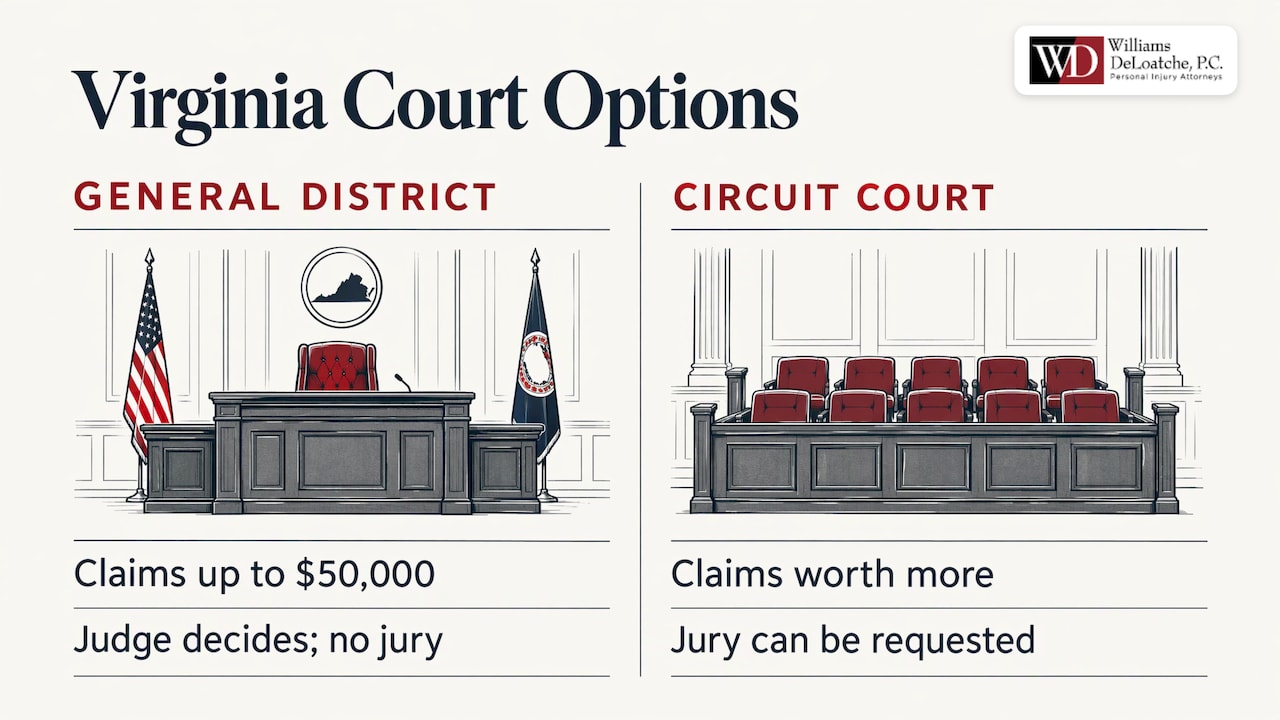
Virginia’s General District Court hears civil personal injury and wrongful death claims up to $50,000, and in that court a judge decides the case with no jury. Claims worth more are filed in Circuit Court, where a jury can be requested. Where you file also depends on where the defendant lives or works, or where the incident happened. For a serious injury, the amount at stake alone usually points to Circuit Court, and the choice of court is part of the strategy we build with you.
What to do after an accident in Chesapeake
The Virginia State Corporation Commission’s auto insurance consumer guide lists the basics, and they apply to most accidents, not only car crashes:
- Get medical care first. Your health comes before the claim. Treatment also creates the medical record that ties your injuries to the accident.
- Call the police if anyone is hurt or the other party is not cooperating, so there is an official report.
- Collect information. Names, addresses, license and registration numbers and insurance company names for every driver and vehicle involved.
- Record the scene. Time, date, location, road conditions, vehicle damage and visible injuries. Photographs and a quick diagram help.
- Get witness names and contact details before people leave.
- Notify your own insurer as soon as possible, and keep copies of every claim form you complete.
A short checklist from an insurance agency covers the same ground if you want something to keep in your glove box. Our own page on steps to take after you have been injured in an accident adds how to keep a record of symptoms and treatment in the weeks that follow.
What to say, and what to hold back
You will hear from the other driver’s insurance adjuster quickly, often within days and sometimes while you are still in pain. Keep these habits:
- Give your name, contact details and basic facts. Do not guess about fault or speed.
- Do not say you are “fine” or “not hurt.” Many injuries, concussions and soft tissue damage in particular, show up hours or days later. Say you are getting checked.
- Decline a recorded statement until you have spoken with an attorney.
- Do not sign a release or accept a quick settlement before you know the full extent of your injuries. A release usually ends the claim permanently.
- Stay off social media about the accident and your activities. Posts get read by insurers.
With us, calls from the other side’s insurer go to your attorney’s office, so you do not have to manage those conversations yourself.
Cases where legal help matters most in Chesapeake
Any injury with medical bills, missed work or a dispute about fault benefits from advice. Some situations are complicated enough that going alone rarely works.
Car accidents
Car crashes are the most common claim. Disputes center on who caused the collision, whether your own coverage applies and how much your injuries are worth. Virginia’s uninsured and underinsured motorist statute, § 38.2-2206, is part of how a claim is paid when the at-fault driver has no insurance or too little. Our Chesapeake car accident attorneys can review which coverages may apply to you.
Truck accidents
A collision with a commercial truck involves more than one driver. The trucking company, the carrier’s insurer, and sometimes the cargo loader or maintenance provider may all be in the picture, and records such as driver logs and inspection history need to be preserved quickly. Read more on what to look for when hiring a truck accident lawyer, or see our truck accident practice.
Motorcycle and pedestrian accidents
Riders and pedestrians have no vehicle around them, so injuries tend to be severe, and insurers sometimes try to shift blame onto the person who was hurt. We explain how we approach these in our guide to a motorcycle accident attorney in Chesapeake and on our motorcycle accidents page.
Traumatic brain injury
A brain injury can change how a person works, remembers and relates to family, and the effects may not be obvious at the emergency room. Because the long-term costs are hard to see early, these claims call for careful medical documentation and patience before settling. Our page on the top brain injury lawyer in Chesapeake explains what families should know, and our traumatic brain injury practice describes how we handle these cases.
Slip and fall and wrongful death
When someone is hurt because a property owner failed to keep a place reasonably safe, the claim is a premises liability case. See our premises liability page. When an injury is fatal, a family may bring a wrongful death claim. These are difficult conversations, and we handle them with care and plain explanations.
How lawyer fees work
Most people worry about cost before they call. In personal injury, the usual arrangement is a contingent fee: the lawyer’s fee depends on the result and is paid from the recovery, so you are not billed hourly while the case is pending. Our firm earns its fee from settlements and verdicts.
Virginia’s Rule of Professional Conduct 1.5, as amended effective July 15, 2025, requires a contingent fee agreement to state in writing how the fee is determined. The agreement must give the percentage that applies if the case settles, goes to trial or goes to appeal, and list the litigation and other expenses that will be deducted from your recovery. It must also say whether those expenses come out before or after the fee is calculated. At the end of the case, the lawyer must give you a written statement of the outcome showing what you received and how it was divided.
That makes this a practical checklist for any engagement letter:
| What to find in the agreement | Why it matters |
|---|---|
| Fee percentage at settlement, trial and appeal | The share can change if the case goes further |
| Case expenses and who advances them | Records, experts and filing costs can be significant |
| Whether expenses come out before or after the fee | It changes your net amount |
| The closing statement | It shows exactly where the money went |
Because the fee comes from the recovery, legal representation is available to people who could not pay a lawyer up front. If money is tight, tell us at the first call. Medical bills and lost wages are exactly the pressures a well-built claim is meant to address.
How to choose a Chesapeake injury lawyer
Search results will show you many firms. These are the criteria that tell them apart.
Direct access to attorneys. Ask who you will talk to when you have a question. A claim can last a year or more, and you should know the attorney and the paralegal handling your file by name. This is central to how we work: our attorneys and paralegals know your case, so you are not starting over each time you call.
Experience with your type of accident. A trucking claim, a brain injury and a slip and fall each depend on different evidence. Look for a firm that handles your kind of case regularly. Our results include a settlement of over $1.5 million in a motor vehicle accident case, and every case is evaluated on its own facts.
Clear communication. You should get plain answers about timelines, what happens next and what the realistic range for your claim is. Updates should come without you chasing them.
A written fee agreement you understand. Use the table above.
Local knowledge. Hampton Roads courts, hospitals, roads and insurers each have their own habits. Our attorneys serve Chesapeake and the surrounding cities, including Portsmouth, where we also have a car accident practice.
Fit. You will share medical and personal details, so you should feel heard. Compassion is not a bonus in this work. It is part of how an injured person gets through the process.
What the first consultation covers
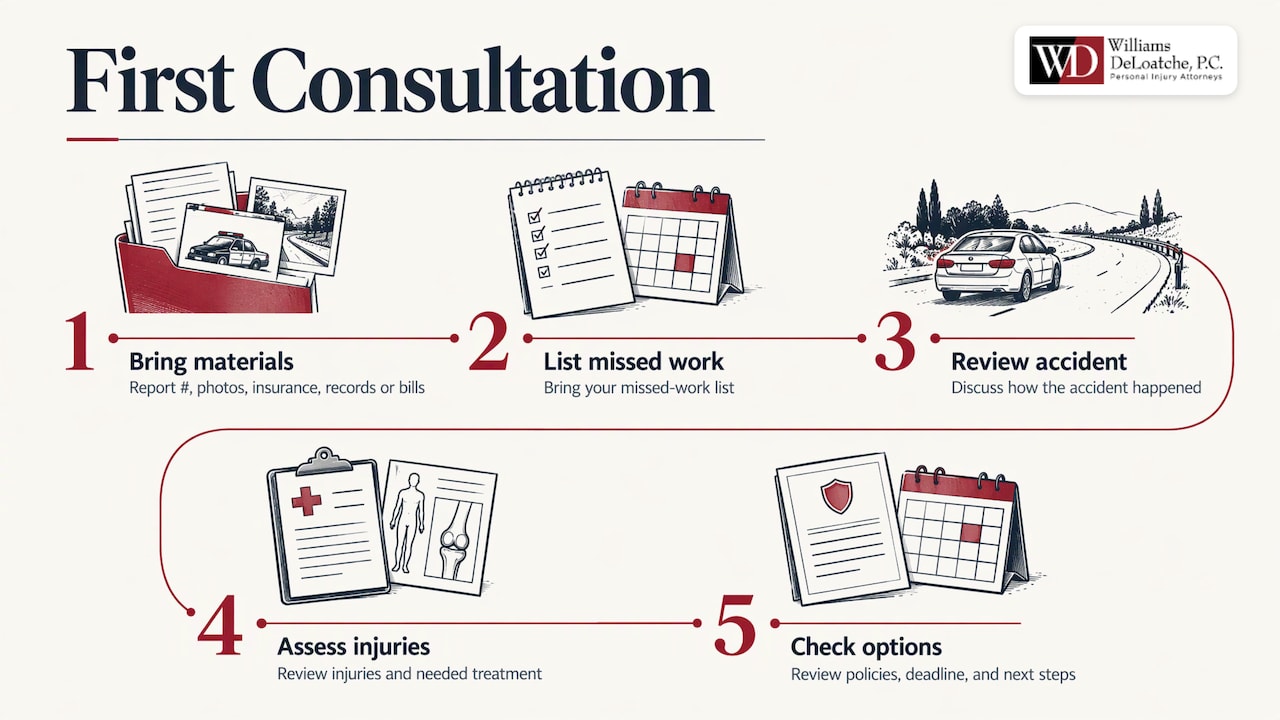
A case evaluation is the starting point. Bring what you have: the police report number, photos, insurance information, medical records or bills, and a list of missed work. If you are missing some of these, that is fine. We can help obtain them.
In the evaluation, we look at how the accident happened, what your injuries are and what treatment you need, which insurance policies may apply, and how close you are to the two-year deadline. You leave with an honest picture of your options and what to do in the coming days.
Talk to Williams DeLoatche about your Chesapeake injury claim
We represent accident victims and their families throughout Hampton Roads with personalized strategies, skilled negotiation and direct access to your attorneys. Whether you were injured in a car, truck or motorcycle crash, a fall or something more serious, we will explain your options in plain terms and handle the insurers while you recover.

See how we can help on our Chesapeake accident lawyers page, or browse all of our personal injury practice areas.
FAQ
How long do I have to file a personal injury claim in Virginia?
For most personal injury lawsuits, Virginia allows two years from when the cause of action accrues, generally the date of the injury. Certain medical malpractice and wrongful death situations follow different rules. Speak with an attorney as soon as you can so evidence is preserved and the deadline never becomes an issue.
What percentage does a personal injury lawyer usually take?
The percentage is set in your written contingent fee agreement, and it may differ depending on whether the case settles, goes to trial or goes to appeal. Virginia’s Rule 1.5 requires the agreement to state those percentages and the expenses that will be deducted. We go through the details with you before you sign.
What should I avoid saying to an injury lawyer or an insurer?
With your lawyer, be fully open: tell us about prior injuries, any statements you already gave and anything on social media, because we can only plan around what we know. With an insurer, stick to basic facts, do not guess about fault, do not say you are uninjured, and do not give a recorded statement or sign a release before speaking with an attorney.
What if I cannot afford a lawyer after an accident?
Because injury representation is typically paid from the recovery rather than by hourly billing, cost does not have to stand between you and a consultation. We explain the fee agreement, including case expenses, before you commit to anything.
Which court would my Chesapeake injury case be in?
Claims up to $50,000 can be heard in General District Court by a judge without a jury, according to the Richmond Bar Association’s court guide. Larger claims go to Circuit Court. Your attorney will recommend where to file based on the value of your claim and the facts.
Sources
- Code of Virginia, Title 8.01, Chapter 4, Article 3 (Personal Actions)
- Virginia Code § 8.01-243
- Virginia Rule of Professional Conduct 1.5, effective July 15, 2025
- Virginia SCC Auto Insurance Consumer Guide
- Virginia Code § 38.2-2206, Uninsured motorist insurance coverage
- Your Guide to Civil Litigation in General District Court, 2023
Recommended

Direct Access.
Real Results.