


Slip and Fall Settlement Amounts in Virginia: What Decides the Number
A slip and fall settlement is an agreement, usually with a property owner’s insurance company, to pay you for your injuries so that you do not have to take the case to trial. There is no standard amount. The figure depends on how badly you were hurt, what the injury costs you, and whether you can prove the property owner was at fault. In Virginia, two rules matter more than in most states: a two-year filing deadline and a strict fault rule that can end a claim entirely. A claim that is documented early and presented with the full cost of your recovery is worth more than one that is rushed.
Key Takeaways
- No reliable “average” settlement exists. Ranges you see online come from different case types, and your claim is valued on your own medical bills, lost income, and pain and suffering.
- Virginia generally gives you two years from the date of injury to file a personal injury lawsuit. A settlement has to be reached, or a suit filed, inside that window.
- Virginia keeps contributory negligence as a complete bar to recovery, so how the insurer describes your own share of the blame matters from the first phone call.
- Photos, incident reports, witness names and medical records collected in the first days are the foundation of the settlement value.
- Most claims settle without a trial, but the timeline depends on how long your treatment takes and how the insurer responds.
Table of Contents
- What a Slip and Fall Settlement Actually Pays For
- Why Reported Settlement Amounts Vary So Much
- The Factors That Move a Slip and Fall Settlement
- A Simple Illustration of How a Claim Is Built
- Virginia Deadlines and Rules You Should Know
- How Long a Slip and Fall Case Takes to Settle
- What to Do in the First Days After a Fall
- Why an Attorney Changes the Value of the Claim
- How We Handle Slip and Fall Claims
- Frequently Asked Questions
- Sources
What a Slip and Fall Settlement Actually Pays For
A slip and fall claim is one kind of premises liability case. Premises liability is the area of law that holds a property owner or occupier responsible when unsafe conditions on the property injure someone. Wet floors, broken stairs, uneven pavement, poor lighting and icy walkways are common causes. You can read more about how these cases work on our Virginia premises liability page.
A settlement is meant to cover your losses. These fall into two groups.
Economic damages are losses with a receipt or a paycheck attached:
- Emergency care, hospital stays, surgery, imaging and medication
- Physical therapy and follow-up visits
- Future medical care your doctors expect you to need
- Wages lost while you recovered, and lost earning ability if you cannot return to the same work
Non-economic damages are the harder-to-price losses:
- Physical pain and suffering
- Emotional distress and anxiety
- Loss of the ability to do things you did before, such as lifting a grandchild or working in the yard
- Scarring or permanent changes to how you move
Both groups belong in the demand you or your attorney sends the insurer. The most common mistake is to count only the bills received so far and leave out treatment still ahead.
Why Reported Settlement Amounts Vary So Much
Search this topic and you will find numbers that range from a few thousand dollars to many millions. They are not wrong, they are just not about you. A bruised hip that heals in three weeks and a shattered wrist that needs surgery and months of therapy are both slip and fall cases, yet they are different claims in every respect.
Amounts quoted online also tend to mix three different things:
- Insurance settlements before suit, the most common outcome.
- Settlements reached after a lawsuit is filed, often higher because the insurer faces a trial date.
- Jury verdicts, which are rare and are headline material because they are unusually large.
A large verdict from another state says little about what a Virginia claim with a different injury will bring. Treat any single average with caution, and ask instead what drives the number in your case.
The Factors That Move a Slip and Fall Settlement
Severity and permanence of the injury
This is the largest driver. Fractures, torn ligaments, spinal injuries and head injuries produce larger claims than sprains and bruises because they cost more to treat and last longer. A fall that causes a head injury deserves particular attention, since symptoms can show up days later. Our page on traumatic brain injury explains why early evaluation matters.
Medical bills and the treatment record
Insurers read the medical record closely. Gaps between visits, a delay in first seeing a doctor, or treatment that stops before you have recovered can all be used to argue that the injury was minor. Following your doctor’s plan protects both your health and your claim.
Lost income
Keep pay stubs and a note from your employer showing the days you missed. If your injury limits the kind of work you can do, that long-term loss can become a significant part of the claim.
Pain and suffering
Virginia has no official formula for pain and suffering. Insurers often use internal methods, such as multiplying medical bills by a number or paying a daily rate, but these are tools for the insurer’s negotiation, not rules of law. What persuades is a clear record: how the injury changed your days, your sleep, your work and your family life. A short daily journal, started early, helps.
Proof that the owner was at fault
Falling on someone’s property does not by itself make them responsible. You generally have to show the owner knew about the hazard, or should have found it through reasonable inspection, and failed to fix it or warn you. Evidence of how long a spill or defect had been there is often the center of the dispute.
Your own share of the blame
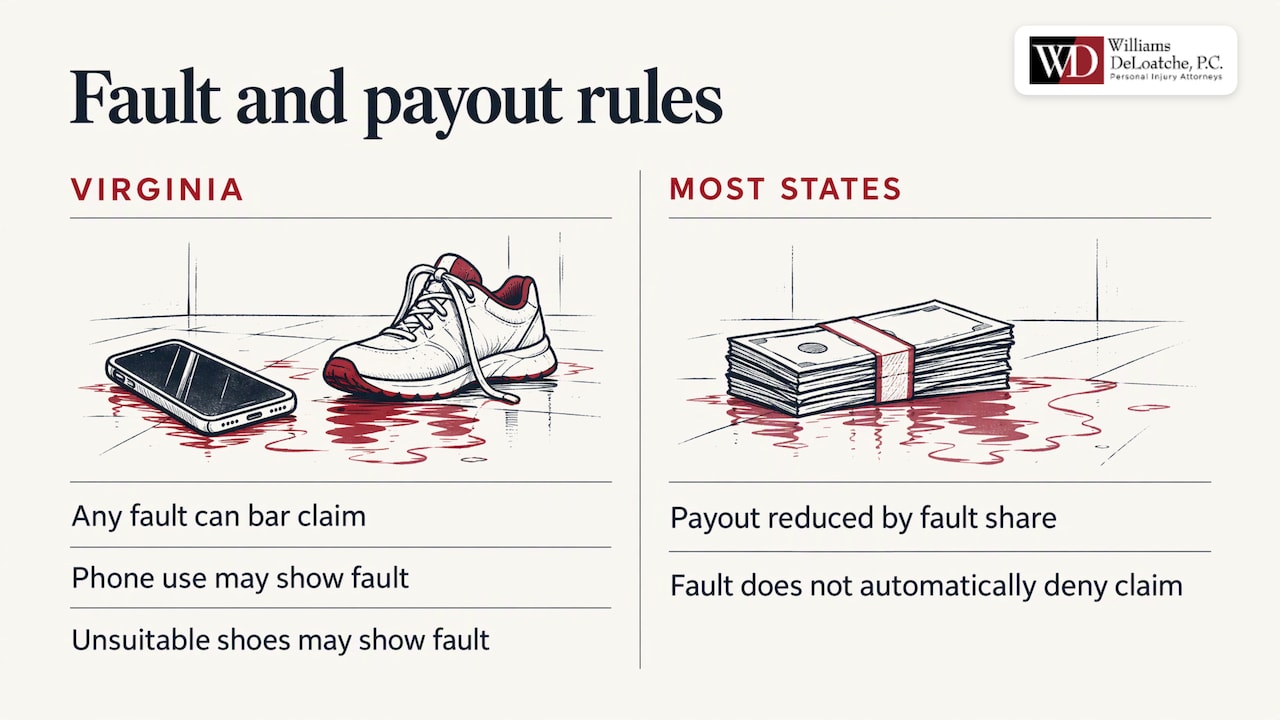
Virginia follows contributory negligence. Under this rule, if the insurer can show you were even slightly at fault, such as by looking at your phone or wearing unsuitable shoes, the claim can be barred completely. Most states reduce a payout by your percentage of fault instead of denying it. That makes Virginia one of the less forgiving places to be hurt, and it is why the way you describe the fall in your first statement matters.
A Simple Illustration of How a Claim Is Built
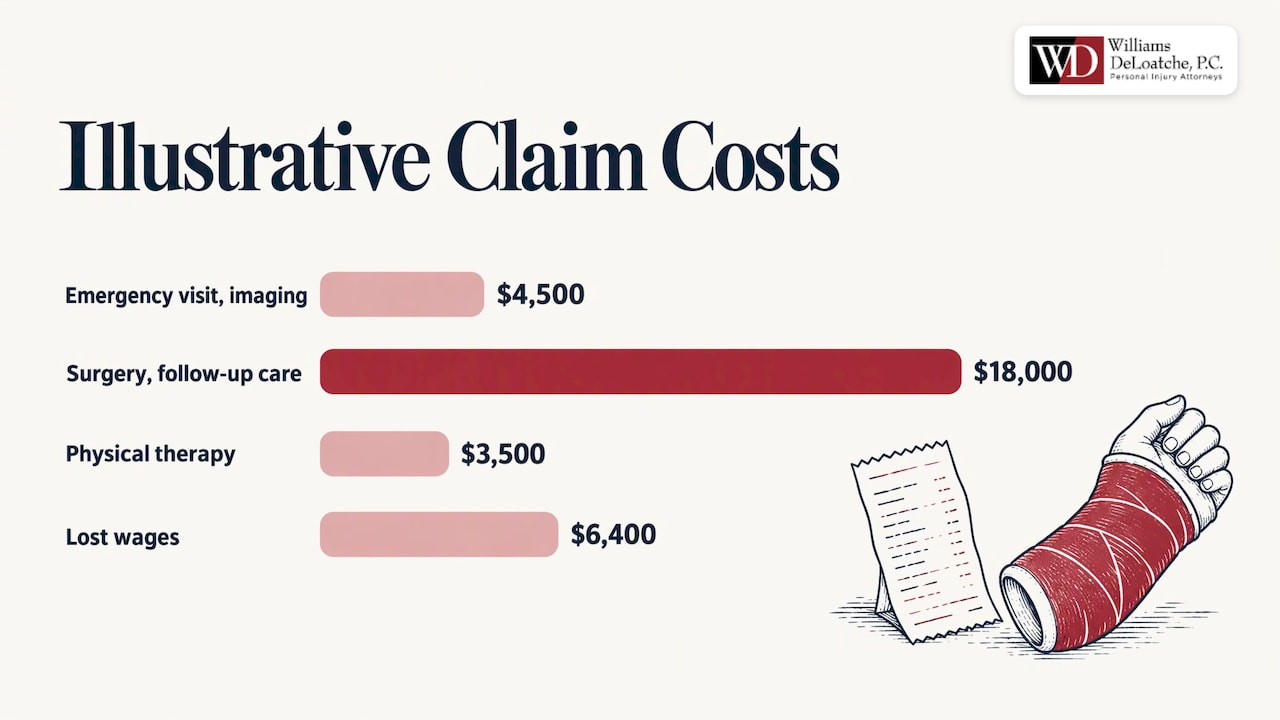
The numbers below are invented to show the arithmetic. They are not a prediction and not a typical result.
Suppose a customer slips on an unmarked wet floor at a Norfolk grocery store and fractures a wrist.
| Item | Illustrative amount |
|---|---|
| Emergency visit and imaging | $4,500 |
| Surgery and follow-up care | $18,000 |
| Physical therapy | $3,500 |
| Lost wages (8 weeks) | $6,400 |
| Total economic losses | $32,400 |
| Pain, suffering and lost activity | Argued separately, based on the recovery |
The insurer’s first offer often addresses only the first rows and treats the last row as small. A complete demand documents each line, adds future care, and explains the non-economic loss with specifics. The gap between those two approaches is where much of the value of a claim is decided.
Virginia Deadlines and Rules You Should Know
The two-year filing deadline. Under Va. Code § 8.01-243, a personal injury lawsuit generally must be filed within two years of the injury. If the deadline passes without a filed suit or a signed settlement, the claim can be lost no matter how strong it was. Exceptions exist, and the clock can differ when a government property is involved, where short notice requirements can apply, so confirm your deadline early.
Settlement is built into the court process. Virginia courts and parties are encouraged to discuss settlement at and in preparation for pre-trial conferences, and voluntary mediation in local courts is governed by Va. Code §§ 8.01-581.21 through 8.01-581.26. Mediation means a neutral third party helps both sides try to reach agreement. In practice, many cases resolve once a lawsuit is on file and a trial date is close.
Release language. When you accept a settlement you sign a release, which ends your right to claim anything further for that fall. Sign only when your treatment picture is clear enough to know what your injury will cost.
How Long a Slip and Fall Case Takes to Settle
There is no fixed timeline. The main factor is your medical recovery. A responsible demand is typically sent when you have finished treatment or reached the point where your doctor can say what to expect. Sending it sooner risks settling for less than your injury ends up costing.
Other things that slow payment:
- The insurer disputes who was at fault, or says you share the blame
- Records or bills arrive slowly from providers
- The property owner and its insurer point at each other, or at a maintenance contractor
- A lawsuit is needed to get a serious offer
If you are paying bills while you wait, tell your attorney early. It affects how a case is paced and how it is presented.
What to Do in the First Days After a Fall
These steps protect your health and your claim. Our guide to types of evidence and how to gather it goes deeper on each.
- Get medical care right away. Even if you feel fine, some injuries appear later. The visit also creates a dated record linking the injury to the fall.
- Report the fall. Ask the store, landlord or manager to write an incident report and request a copy. Do not guess about the cause in writing.
- Photograph the scene. Capture the hazard, the lighting, the surrounding area and your injuries before anything is cleaned or repaired. Photograph your shoes too.
- Collect witness names and numbers. Employees and other customers can confirm what the floor looked like.
- Keep your medical reports and bills in one folder, along with proof of missed work.
- Be careful with the insurer. An adjuster may ask for a recorded statement. Because Virginia can bar a claim over a small share of fault, speak with an attorney before giving one.
- Do not post about the fall or your recovery on social media. Insurers look.
If you want to understand how owners are expected to keep property safe, our post on premises liability and your rights covers the duty they owe visitors.
Why an Attorney Changes the Value of the Claim
Insurers handle these claims every day. You are handling one for the first time, while injured. An attorney builds the liability case, gathers the records, counts the future care and lost income that early offers leave out, and negotiates from a position that a trial is possible. Because Virginia’s fault rule is unforgiving, an attorney also helps protect you from statements that give the insurer a reason to deny the claim.
For many people the worry is cost. Personal injury firms like ours are paid from the settlement or verdict, so you are not paying hourly while you recover. Ask about the fee arrangement at the first meeting so you know exactly how it works.
How We Handle Slip and Fall Claims
Williams DeLoatche, P.C. represents accident victims across Virginia, including Hampton Roads, with a focus on personalized support: you have direct access to your attorneys, and attorneys and paralegals know your case rather than treating you as a file number. We build a strategy around your injury and your circumstances, and we negotiate with skill and keep you informed at each stage. Our firm has secured substantial settlements for clients, including over $1.5 million in a motor vehicle accident case.
If you were hurt in a fall in Norfolk, Virginia Beach, Chesapeake or elsewhere in Virginia, read about our slip and fall legal representation or contact us for a case evaluation.

Other injuries from unsafe property are covered across our personal injury practice areas.
Frequently Asked Questions
How much is the average slip and fall settlement?
There is no dependable average, because published ranges blend minor and catastrophic injuries and settlements with verdicts. Your claim is valued on your medical costs, lost income, the permanence of the injury, and how well fault can be proven. A case review with an attorney gives a far more useful estimate than any online number.
How is pain and suffering calculated?
Virginia law sets no formula. Insurers often use a multiple of medical bills or a daily rate as a negotiating tool, but a fair figure rests on how the injury affected your life, how long it lasts, and the medical record that supports it. A journal and consistent treatment strengthen this part of the claim.
Can I still recover if I was partly at fault?
In Virginia, probably not if the insurer can prove you were even slightly at fault, because the state keeps contributory negligence as a complete bar. This is why the facts of how you fell, and what you say about it, need care. Talk with an attorney before you give a statement.
How long do I have to file a slip and fall claim in Virginia?
Generally two years from the date of the injury under Va. Code § 8.01-243. Claims involving government property can carry shorter notice requirements, so do not wait to find out which deadline applies to you.
Sources
- Va. Code § 8.01-243, Virginia Law (official statute text)
- Virginia personal injury statute of limitations and contributory negligence summary
- ICLG, Litigation & Dispute Resolution Report 2026: USA, Virginia
Recommended

Direct Access.
Real Results.