


Catastrophic Injury Lawyer in Virginia: What to Look For
A catastrophic injury lawyer handles claims where an accident has changed someone’s life for good: a brain injury, a spinal cord injury, an amputation, severe burns or the loss of a family member. If you or someone you love is in that position in Virginia, you need a firm that will value the whole future cost of the injury, not just the bills on your desk today, and that keeps you in direct contact with the attorneys doing the work. At Williams DeLoatche, P.C., that is how we approach these cases. Clients have direct access to their attorneys, and the attorneys and paralegals know the case.
This guide explains what “catastrophic” means in a legal claim, what compensation can cover, the deadline that applies in Virginia, and how to judge a lawyer before you sign anything.
Key Takeaways
- A catastrophic injury is one with permanent or long-term effects, such as a traumatic brain injury, spinal cord injury, amputation or severe burns. Its cost runs for years, so the claim has to account for the future.
- Virginia’s general deadline for a personal injury lawsuit is two years from when the claim accrues, under Va. Code § 8.01-243(A). Exceptions exist, so act early.
- No average settlement figure is reliable. Each claim is valued from that person’s medical needs, lost income and the evidence of what the injury has changed.
- Contingency fee representation means legal fees come out of a settlement or verdict. Low income is not a barrier to getting a serious case reviewed.
- Choose a lawyer on access, preparation and experience with your type of crash, not on advertising.
Table of Contents
- What counts as a catastrophic injury
- Where catastrophic injuries happen in Virginia
- What a catastrophic injury lawyer does
- What compensation can cover
- How the value of a claim is assessed
- Evidence that supports a serious injury claim
- The Virginia deadline
- Costs: how people with limited income can hire a lawyer
- How to choose a catastrophic injury lawyer
- Talk to Williams DeLoatche about your case
- FAQ
- Sources
What counts as a catastrophic injury
There is no single legal checklist. In practice, lawyers and insurers use “catastrophic” for an injury that is severe, permanent or long-lasting, and that prevents or sharply limits a normal life and work. The common examples are:
- Traumatic brain injury (TBI): damage to the brain from a blow or violent jolt. Effects can include memory loss, personality change, trouble with concentration, headaches and loss of independence. Our page on traumatic brain injury claims covers these in more detail.
- Spinal cord injury: partial or complete paralysis, often requiring a wheelchair, home changes and daily care.
- Amputation: the loss of an arm, leg, hand or foot, followed by surgeries, prosthetics that need replacing and rehabilitation.
- Severe burns: repeated surgeries, skin grafts, scarring and long-term pain.
- Crush injuries, multiple fractures and organ damage: especially after truck or motorcycle crashes.
- Wrongful death: not an injury to the victim you can recover for, but a loss that leaves a family with funeral costs, lost income and lost support. See our Virginia wrongful death practice page.
If your injury is serious but you are not sure it fits, that is a reason to ask, not to wait. Our Serious Injury Guide walks through the early steps after a serious accident.
Where catastrophic injuries happen in Virginia
The causes differ by region, and so does the kind of help families need.
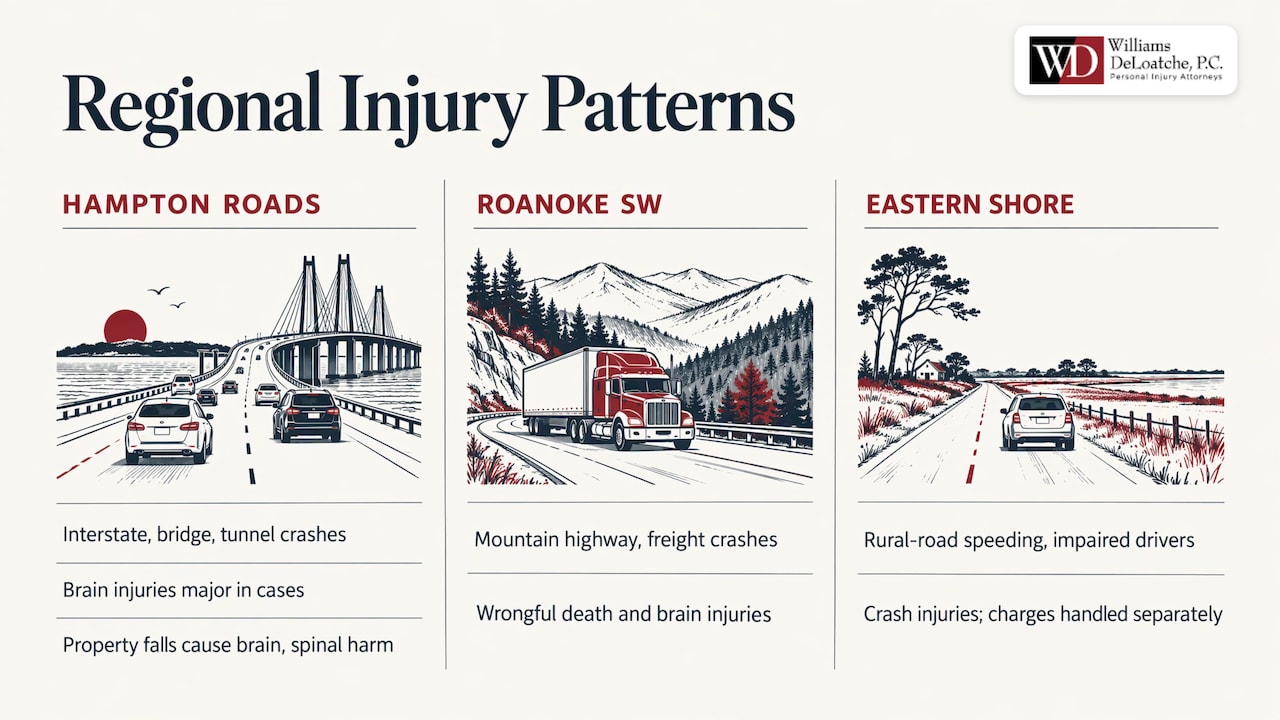
Hampton Roads (Williamsburg to Virginia Beach). Heavy commuter traffic on the interstates, bridges and tunnels, along with busy tourist roads, produces serious car, truck and motorcycle crashes. Slip and fall injuries on someone else’s property can also cause brain and spinal harm. Brain injuries are a major part of the cases we see in this region.
Roanoke and southwest Virginia. Mountain highways and interstate freight corridors mean tractor-trailer crashes, car collisions and motorcycle wrecks. Families here also come to us after a wrongful death or a brain injury. Our truck accident page for Christiansburg explains how those claims work.
Virginia’s Eastern Shore (Accomack and Northampton counties). Long rural stretches of road carry speeding, reckless and impaired drivers. A crash with a car or truck there can leave a serious injury, and the driver may also face charges for speeding, reckless driving or DUI. Those charges are a separate court matter from your injury claim, and our attorneys can help you understand how each affects the other.
What a catastrophic injury lawyer does
A serious injury claim is a different job from a fender-bender claim. The lawyer’s work usually includes:
- Case evaluation. Reviewing the crash or incident, the medical picture and who may be legally responsible.
- Preserving evidence. Photos, video, vehicle data, witness names and medical records can disappear or be altered. A lawyer acts early to protect them.
- Identifying every source of recovery. A truck crash may involve a driver, a carrier and a maintenance company. A fall may involve a property owner and a manager. Insurance policies on each may apply.
- Building the full value of the claim. This means working with your doctors and, where the case calls for it, outside experts to describe what care you will need and what you will lose.
- Negotiating with insurers. Our firm uses skilled negotiation to pursue maximum compensation for clients. We have secured settlements for clients that include over $1.5 million for a motor vehicle accident.
- Taking the case to court if needed. If the insurer will not offer fair compensation, the claim can be filed as a lawsuit within the time limit.
You do not have to manage insurance adjusters, medical-bill disputes and deadlines while you or a relative is in the hospital. That is the practical reason to bring in a lawyer early. Our personal injury practice areas show the types of claims we take.
What compensation can cover
Compensation in a personal injury claim is called damages. In a catastrophic case, they generally fall into these groups:
| Type of loss | What it can include |
|---|---|
| Medical expenses | Emergency care, surgery, hospital stays, rehabilitation, medication, equipment |
| Future medical care | Ongoing therapy, replacement prosthetics, attendant care, home or vehicle modifications |
| Lost income | Wages lost since the injury and reduced earning ability afterward |
| Pain and suffering | Physical pain, emotional distress and loss of enjoyment of life |
| Wrongful death losses | Funeral expenses and the financial and personal losses a family suffers |
The future-care line is where catastrophic claims differ most. A settlement that covers this month’s hospital bill but ignores thirty years of care leaves the family to pay the rest. Because a settlement usually ends the claim, the amount has to be right before you accept it.
How the value of a claim is assessed
Readers often ask for an average settlement for a serious injury. There is no number worth trusting, because the cases are too different. A brain injury in a 25-year-old who cannot return to work has a very different future cost from a fracture in a retiree. The value is built from facts specific to the person:
- Medical needs: what treatment has happened and what your doctors expect will be needed.
- Earning capacity: your age, job, training and what the injury now prevents you from doing.
- Daily life: whether you need help with bathing, dressing, driving or supervision, and who provides it now.
- Fault: how clearly the other party caused the harm. Virginia is strict on shared blame, so any claim that you were partly at fault needs to be taken seriously and answered with evidence from the start.
- Insurance and other sources: the policy limits available and whether more than one party is responsible.
Be cautious with early insurer offers. An adjuster may call quickly and ask for a recorded statement or a release. Before you give either, speak with an attorney. Once you sign a release, you generally cannot ask for more later, even if your condition turns out to be worse than first thought.
Evidence that supports a serious injury claim
The records that show what happened and what it has cost are what carry a claim. Start gathering or preserving:
- Police or incident reports and the names of witnesses
- Photos and video of the scene, vehicles, hazards and your injuries
- Medical records, imaging, bills and discharge instructions
- Notes from doctors about long-term restrictions or future treatment
- Pay stubs, tax returns and employer letters showing lost income
- A simple daily journal of pain, symptoms, missed events and tasks you can no longer do
- Receipts for out-of-pocket costs, from mileage to medical equipment
Families of someone who cannot speak for themselves can start this file too. Keep every document and do not post about the accident on social media, since insurers look at public posts.
The Virginia deadline
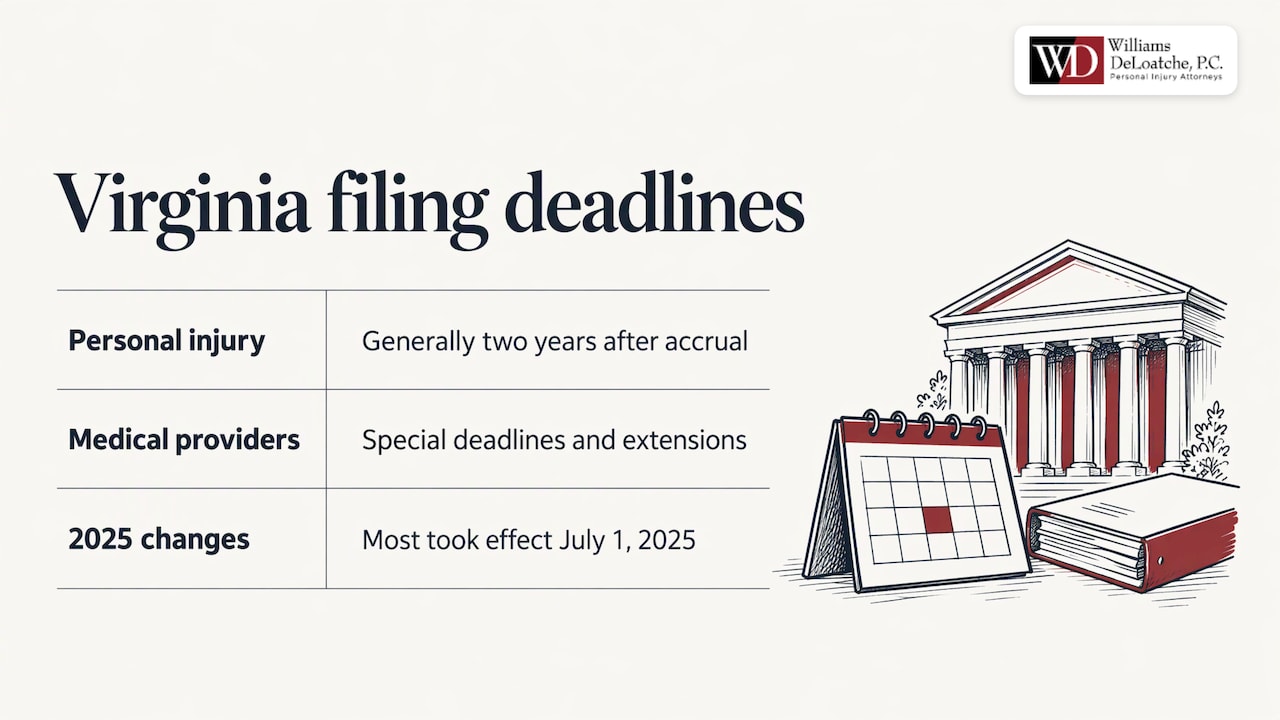
Virginia law sets a time limit on lawsuits. Under Va. Code § 8.01-243(A), a personal injury action generally has to be brought within two years after the claim accrues, unless another statute provides otherwise. Claims against medical providers follow special provisions in subsection © of the same section, with different deadlines and extensions in certain circumstances. Which rule applies depends on your facts.
Two years sounds long. In a catastrophic case it passes quickly, because treatment is ongoing and the full extent of the injury may not be clear for a long time. Evidence also gets harder to find. If you miss the deadline, the court can refuse to hear the case at all. Our article on how long you have to file a personal injury claim in Virginia goes through the details. Virginia also updates its laws every year, and the General Assembly’s 2025 summary of changes shows most 2025 changes took effect July 1, 2025. A lawyer checks current law for your date of injury.
Costs: how people with limited income can hire a lawyer
Cost stops many families from calling. Our firm is paid through contingency fees: the fee comes from a settlement or court award, not from money you have to find while you are out of work and facing medical bills. We do not publish a fee schedule, so ask us about the terms for your case at the first conversation. Case costs and fee terms should be explained in writing before you sign, and you should understand how they are handled when a case ends.
This arrangement is why a family with little income can still have a serious case taken on. If you are unsure whether you can afford representation, call and describe your situation.
How to choose a catastrophic injury lawyer
Use these questions at your first conversation.
Will I talk to an attorney? Large claims run for a long time. You should be able to reach the attorneys on your case, not only an intake line. At Williams DeLoatche, clients are not just a number, and the attorneys and paralegals are familiar with each case.
Has the firm handled cases like mine? Ask about experience with brain injuries, truck crashes, motorcycle crashes or wrongful death, whichever is yours. You can meet our Virginia personal injury attorneys before you call.
Is a strategy built for my situation? A plan for a young parent with a spinal injury should look different from a plan for a retiree. Expect questions about your work, your family and your care needs.
Will you explain things plainly? You should understand each step, each offer and each choice in plain language.
Is the office close enough? Our Virginia law offices and service areas cover Hampton Roads, the Eastern Shore and the Roanoke area.
Talk to Williams DeLoatche about your case
Williams DeLoatche, P.C. is a personal injury firm serving clients across Virginia. We handle car accidents, truck accidents, motorcycle accidents, traumatic brain injury and wrongful death claims, and we aim to pursue the maximum compensation the facts support. If you or your family are dealing with a life-changing injury, contact us through our practice areas page to start a case evaluation.

FAQ
What qualifies as a catastrophic injury?
It is a severe injury with permanent or long-term effects that limits your ability to work or live independently. Common examples are traumatic brain injury, spinal cord injury, amputation and severe burns. There is no single legal list, so a lawyer looks at how the injury changes your life and care needs.
How long do I have to file a catastrophic injury lawsuit in Virginia?
Virginia generally allows two years from when the claim accrues for a personal injury action, according to Va. Code § 8.01-243(A). Medical malpractice and other claims can follow different rules. Because evidence fades and treatment takes time, contact a lawyer as soon as you can.
What is the average settlement for a catastrophic injury?
No reliable average exists. Value depends on future medical care, lost earning capacity, the effect on daily life, fault and the insurance coverage available. A lawyer can estimate a range for your case after reviewing your records.
Can I afford a catastrophic injury attorney?
Our firm earns its fee through contingency fees from a settlement or court award, so the fee is not paid out of your pocket while you recover. Ask about the specific terms for your case during your first conversation.
Sources
- Code of Virginia, Title 8.01, Chapter 4, Article 3: Personal Actions (§ 8.01-243)
- 2025 Changes to Virginia’s Laws, Virginia Division of Legislative Services
Recommended

Direct Access.
Real Results.