


Nursing Home Neglect Lawyer in Virginia: When to Call One
If a loved one in a Virginia nursing home has bedsores, unexplained injuries, sudden weight loss or repeated falls, you should speak with a nursing home neglect lawyer as soon as you can, and report the problem in writing at the same time. A lawyer can gather the facility’s records, work out who is legally responsible and pursue compensation for the harm, while you stay focused on your family member’s care. At Williams DeLoatche, P.C., our nursing home abuse attorneys represent families across Virginia, and you can reach an attorney directly to talk through what you have seen.
TL;DR
- Neglect is a failure to give a resident the care they need to avoid harm. Federal rules require nursing homes to prevent it, investigate it and train staff to recognize it.
- Common warning signs include untreated bedsores, dehydration, malnutrition, unexplained bruises or fractures, poor hygiene, medication errors and sudden changes in mood or behavior.
- Report in writing, date it, keep a copy and keep a log of what you observe. Call 911 if your family member is in immediate danger.
- Compensation can cover medical bills, pain and suffering, emotional distress and, in some cases, funeral costs or punitive damages.
- Deadlines for filing a claim are strict, so the earlier a lawyer reviews your situation, the more evidence can be secured.
Table of Contents
- What counts as nursing home neglect
- Warning signs families should know
- What to do the day you suspect neglect
- Why families hire a lawyer instead of handling the claim alone
- How a nursing home neglect case is built
- What compensation can cover
- Deadlines and why timing matters
- Our nursing home abuse practice
- FAQ
- Sources
What counts as nursing home neglect
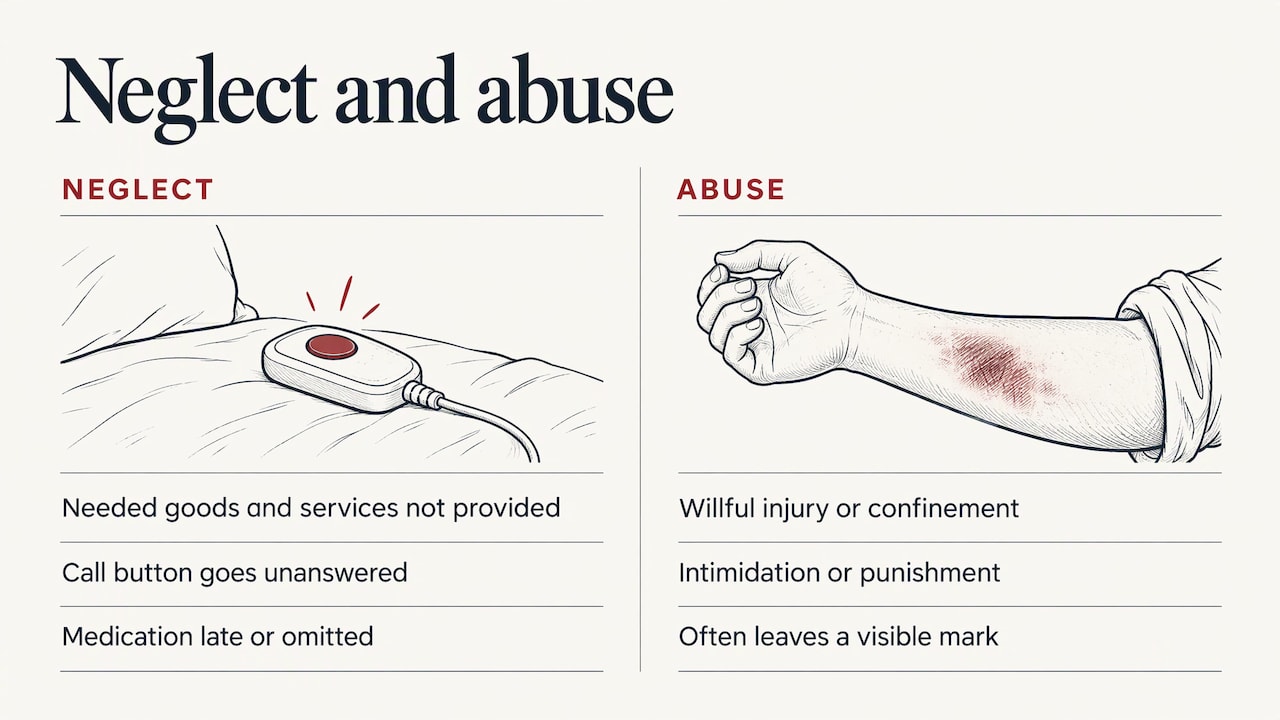
Neglect is usually about something that did not happen. CMS, the federal agency that oversees nursing homes, defines neglect as a failure to provide the goods and services a resident needs to avoid physical harm, mental anguish or mental illness. It defines abuse as the willful infliction of injury, unreasonable confinement, intimidation or punishment that causes physical harm, pain or mental anguish.
The difference matters because the two often look different from the outside. Abuse tends to leave a mark someone can point to. Neglect builds quietly: a call button that goes unanswered, a resident who is not turned in bed, meals left out of reach, medication given late or not at all. The National Association of Attorneys General notes that neglect commonly involves an omission or failure to act, and that staff negligence can lead to bedsores, falls, medication errors and inadequate infection control.
What the law requires of a facility
A nursing home that accepts Medicare or Medicaid funding must follow federal regulations. Under 42 C.F.R. §483.12, residents have the right to be free from abuse, neglect, exploitation, misappropriation of property, corporal punishment, involuntary seclusion and restraints used for discipline or convenience rather than medical need. The facility must prohibit and prevent these things, investigate allegations and provide required staff training.
That regulation is the baseline a lawyer measures a facility against. When a resident is hurt, the question is whether the home met the standard it was legally obliged to meet. CMS also states that if abuse or neglect has occurred, the administrator or director of nursing is responsible for investigating the cause or removing the resident to safety.
Warning signs families should know
You do not need a medical degree to notice that something has changed. Several federal and professional sources list the same patterns.
The U.S. Department of Justice’s Elder Justice Initiative lists red flags such as:
- Bruises, fractures and untreated injuries
- Medication overdose or underuse
- Sudden behavioral changes
- Caregivers isolating the resident from visitors
- Dehydration and malnutrition
- Untreated pressure sores and poor hygiene
- Unsafe or unsanitary conditions
- Abandonment
The National Institute on Aging adds preventable bedsores, missing assistive devices, hazardous or unclean surroundings, unexplained burns, withdrawal, agitation, unexplained financial losses and unpaid bills despite adequate resources. A guide on nursing home neglect drawing on the National Consumer Voice for Quality Long-Term Care also lists unexplained weight loss, missing canes, wheelchairs, eyeglasses or dentures, untreated infections and unexplained falls.
A single sign does not prove a claim. A pattern does: a bedsore that appears, worsens and ends in hospitalization; weight that drops over three months with no care-plan change; falls that repeat in the same unsupervised hallway. For more detail, our guides on the signs of nursing home abuse and why nursing home falls happen walk through what to look for during visits.
What to do the day you suspect neglect
Your first priority is your family member’s safety. Your second is a record. Here is the order we would follow.
- Act on danger first. If there is immediate danger or a possible crime, the National Consumer Voice advises calling 911 or local police, getting medical care and preserving physical evidence where appropriate.
- Listen to your loved one. The same guidance recommends open-ended questions and treating a resident’s report as credible unless there is a reason not to, including when the resident has dementia.
- Report in writing. A state health department guide advises putting the report in writing, dating it and keeping a copy. Include who was harmed, the facility and caregivers involved, the nature and extent of the harm, earlier incidents, and when and where it happened. Then follow up.
- Tell the right agencies. Report to the facility administrator, the Long-Term Care Ombudsman, Adult Protective Services and the state licensing agency. The federal Long-Term Care Ombudsman Program operates in every state and can enter facilities, speak with residents and review relevant records.
- Keep an incident log. The Kentucky Attorney General’s guidance on protecting residents recommends recording dates, times, locations, physical or emotional changes, witnesses, staff responses, medical treatment and photographs. The advice applies equally in Virginia.
- Call a lawyer early. Reports to agencies protect your family member. A lawyer protects the claim.
Our article on what to do if you suspect nursing home abuse covers these steps in more depth, and if you worry about staff reacting badly to a complaint, read what to do if a nursing home retaliates.
If you are in Virginia Beach, Norfolk, Chesapeake, the Eastern Shore or the Roanoke area, you can start the legal side of this list the same day by calling us.
Why families hire a lawyer instead of handling the claim alone
A neglect claim is rarely one person’s mistake. It often involves a facility owner, a management company, a medical director and an insurer, each with its own records and its own lawyers. Families who try to deal with the facility directly usually meet an administrator who is courteous, an insurer who asks for a recorded statement and a records request that takes weeks.
A lawyer takes that burden off you in concrete ways:
- Records. Care plans, medication logs, staffing schedules, incident reports and nursing notes show what the facility knew and when. Attorneys know which records to ask for and how to read them.
- Responsibility. Ownership of nursing homes is often layered. Litigation materials for attorneys address identifying corporate owners and deposing nursing home employees, and the federal Nursing Home Reform Act and staffing requirements are part of how responsibility is measured.
- Independent evidence. Federal survey rules require inspectors to examine the quality of medical, nursing, dietary, sanitation and infection-control care and audit care plans. State survey agencies must receive and promptly investigate allegations of neglect and abuse, separately from any private lawsuit. Survey findings can become part of the proof when a lawyer knows how to obtain and use them.
- Negotiation. Insurers evaluate a claim by what is documented. Skilled negotiation turns a well-organized record into a fair offer, and a case prepared for trial changes how that offer is made.
Our approach is built around direct access to your attorney, a strategy shaped by your family member’s circumstances and clear communication about where the case stands. You should not have to chase a paralegal to learn whether a records request came back.
How a nursing home neglect case is built
Every case differs, but the path usually looks like this.
1. Case evaluation
We start with what happened, who was involved and what harm followed. Bring whatever you have: the admission paperwork, the log you kept, photographs, hospital discharge papers and the names of staff who spoke with you. If you are unsure which documents matter, our guide to three things to bring to a nursing home case is a good checklist.
2. Investigation and evidence
The facility’s own records are the core of the case. Medical records show what was ordered. Staffing records show whether enough people were working. Inspection reports show whether the problem was known. Evidence tends to disappear over time, which is why early action matters. Read how evidence wins nursing home cases and how to prove nursing home abuse in court.
3. Demand and negotiation
Once the harm and its cost are documented, the claim goes to the facility’s insurer. Many claims resolve here. Our role is to present the evidence clearly and to advise you honestly on any offer.
4. Litigation if needed
If the insurer will not offer fair compensation, the case can proceed to a lawsuit, with depositions of staff and administrators and, if necessary, a trial.
What compensation can cover
The damages in a neglect claim depend on the harm. Nolo’s legal guide to nursing home lawsuits explains that compensatory damages may include economic losses, such as medical and hospital bills and funeral and burial costs if the resident dies, and noneconomic losses, such as pain and suffering, emotional distress and loss of enjoyment of life. Punitive damages may be awarded where the mistreatment is a particularly egregious pattern of abuse or neglect.
If a resident dies because of neglect, a family may bring a wrongful death claim, which has its own rules about who may file and what may be recovered. Our wrongful death practice page explains how we approach those cases. Where neglect led to a head injury from a fall, the traumatic brain injury page covers the long-term costs we account for.
Why outcomes vary
You will see searches for the “average settlement” for nursing home neglect. An average is a poor guide, because outcomes depend on facts specific to each case:
- How severe the injury was and whether it caused hospitalization, permanent harm or death
- How well the neglect is documented in the facility’s own records
- Whether there is a pattern, such as repeated falls or understaffing, that points to a facility-wide problem
- The resident’s age, health and life expectancy
- The limits of available insurance and who can be held responsible
- The state’s rules on damages, which differ from state to state
That last point is why out-of-state examples are unreliable. Some states cap certain damages, others allow enhanced remedies, and what applies to a Virginia resident is a question for a Virginia attorney, not for a settlement figure from another state’s web page. We evaluate each claim on its own record and tell you plainly what we see.
Deadlines and why timing matters
Every claim has a filing deadline, called a statute of limitations, and a case filed after it can be barred no matter how strong it is. Deadlines can differ depending on whether the claim is for personal injury, wrongful death or medical negligence, and the clock can start at different points. Because we cannot responsibly give you a single number without reviewing your facts, our advice is simple: do not wait to find out. Call an attorney now, and we will tell you exactly which deadlines apply to your family’s situation.
Waiting also affects evidence. Staff turn over, memories fade, and records can be altered or lost. A prompt request to preserve them is one of the most useful first steps a lawyer can take.
Our nursing home abuse practice
Williams DeLoatche, P.C. is a personal injury firm serving clients throughout Virginia, including Hampton Roads, the Eastern Shore and the Roanoke area. Our nursing home abuse lawyers handle neglect and abuse claims for residents and their families, and you will speak with an attorney directly, not only with intake staff. We earn our fee through a contingency arrangement from settlements and verdicts, so families do not pay hourly legal fees to bring a claim.

If you are not sure whether what you saw is neglect, that is a good reason to call, not a reason to wait. Tell us what happened, and we will explain your options. You can also see our full list of practice areas or visit our home page.
FAQ
How do I know if I need a nursing home neglect lawyer or just a complaint to the state?
A complaint to the Ombudsman, Adult Protective Services or the licensing agency can prompt an investigation, but it does not compensate your family member for harm already done. If your loved one was injured, hospitalized or declined because of poor care, a lawyer can pursue compensation while the agencies review the facility.
What does a nursing home neglect lawyer cost?
Our firm earns its fees through contingency fees from settlements and court verdicts, so you do not pay hourly legal fees to bring a claim. We explain the fee arrangement during your first conversation, before you decide to hire us.
Can I bring a claim if my family member has dementia or has died?
Yes. A resident’s reports should be treated as credible even with dementia, and the facility’s records often tell the story. If the resident has died because of neglect, family members may be able to bring a wrongful death claim. An attorney can tell you who may file under Virginia law.
What should I bring to my first meeting?
Bring the admission contract, medical and hospital records you have, photographs, your incident log, copies of any written reports and the names of staff or witnesses. If you do not have everything, come anyway: we can request the facility’s records ourselves.
Sources
- 42 C.F.R. §483.12, Freedom from abuse, neglect and exploitation
- CMS Nursing Home Toolkit
- U.S. Department of Justice, Red Flags of Elder Abuse
- National Institute on Aging, Elder Abuse
- Nursing Home Neglect: Preventing It and Getting Help
- National Association of Attorneys General, Long-Term Care Facilities
- Nursing Home Abuse: How to Spot it and How to Get Help
- Neglect & Abuse reporting guide
- Kentucky Attorney General, How to Protect Nursing Home Residents
- Nursing Home Litigation: Regulations, Discovery and Damages
- 42 CFR §488.305, Standard surveys
- 42 U.S.C. §1396r
- Nolo, A Guide to Nursing Home Abuse and Neglect Lawsuits
Recommended

Direct Access.
Real Results.